



Students in John Prow’s STEM fishing class at St. Cloud Middle School have hooked another opportunity to work with the Florida Fish and Wildlife Conservation Commission.
The class embarked on a study in partnership with FWC last year to determine whether bass from areas with little to no fishing pressure are easier to catch than those from heavily fished lakes like Lake Tohopekaliga.
Through electrofishing, FWC employees gathered educated fish from Lake Toho and uneducated fish from a strictly off-limit pond at Orlando International Airport. Microwire tags were inserted into the fish, and they were relocated to the SCMS pond.
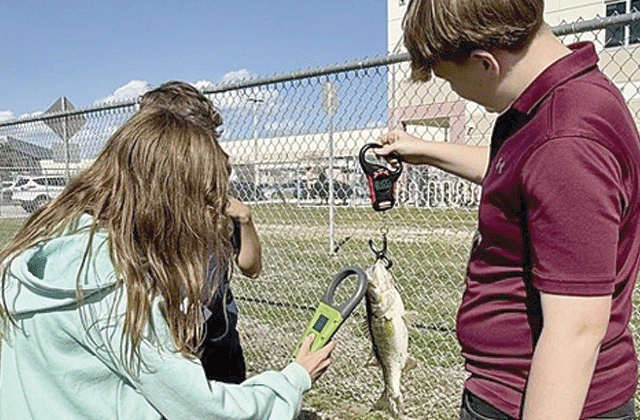
Prow’s class used a wand from FWC to scan each fish the class caught, and they sent information back to researchers: whether it registered as an uneducated fish, an educated fish, or one of the untagged fish already present in the school’s pond.
Now in its second year, the partnership with the FWC has expanded from a single pond to three ponds across the school campus, allowing students to take part in a more comprehensive study.
Students from John Prow’s St. Cloud Middle School science class scan fish they catch in a local pond and send information back to Fish and Wildlife Commission researchers. (Submitted photo) “The main hypothesis is that unpressured bass will exhibit higher catchability,” said FWC biologist Logan Masterson, who is heading the study. “Fish in high-pressure environments may become more selective or conditioned to avoid angling gear.”
Early results appear to support that theory. So far, students have caught and scanned 23 unpressured bass compared to seven from a more heavily fished population.
If the trend continues, the findings could influence how fish are stocked for programs designed to introduce young anglers to the sport, potentially improving success rates and participation.
For students, however, the impact is immediate.
On any given day, students can be found casting lines using a variety of techniques—from spinnerbaits and swimbaits to soft plastic worms—all while experimenting with different retrieves and different parts of the water column. “As it is in fishing, it’s a never-ending experiment to try to determine what might trigger a bite,” Prow said.
The class includes a mix of experienced anglers and students who have never fished before—many catching their first fish during the project.
“A kid catching a fish for the first time is hard to beat,” Prow said.
“They generate the bites, land the fish, scan for a tag, and analyze the data,” Prow said. “I don’t know how you could design something more perfect for engaging them in science.”
Prow explained that the process involved in fishing and specifically bass fishing lines up directly with the experimental design process taught at all three grades in middle school. Along with the life science curriculum such as food chains, food webs, and energy pyramids, it is the basis for the elective course itself.
“Watching kids learning about nature and connecting to nature is a gift,” Prow said. “Watching kids get better at the mechanics of casting and using a rod and reel is no different than learning how to use an instrument or play a sport. The excitement of each fish catch and the moment we scan to check a tag is just cool!”
One of the most rewarding aspects of this project for Masterson has been the opportunity to engage in outreach and share fisheries science with a younger audience.
“During activities such as stocking fish in their ponds, I was particularly impressed by the students’ level of interest and curiosity,” he said. “They asked thoughtful, insightful questions and were genuinely engaged in the process, which made it clear they were not only enjoying the experience but also understanding the science behind it. “
The research is expected to continue for at least another one to two years, with additional data collection helping refine the results. In the meantime, students are gaining something just as valuable—a deeper connection to science and the natural world, one cast at a time.
