



By Dana Bove
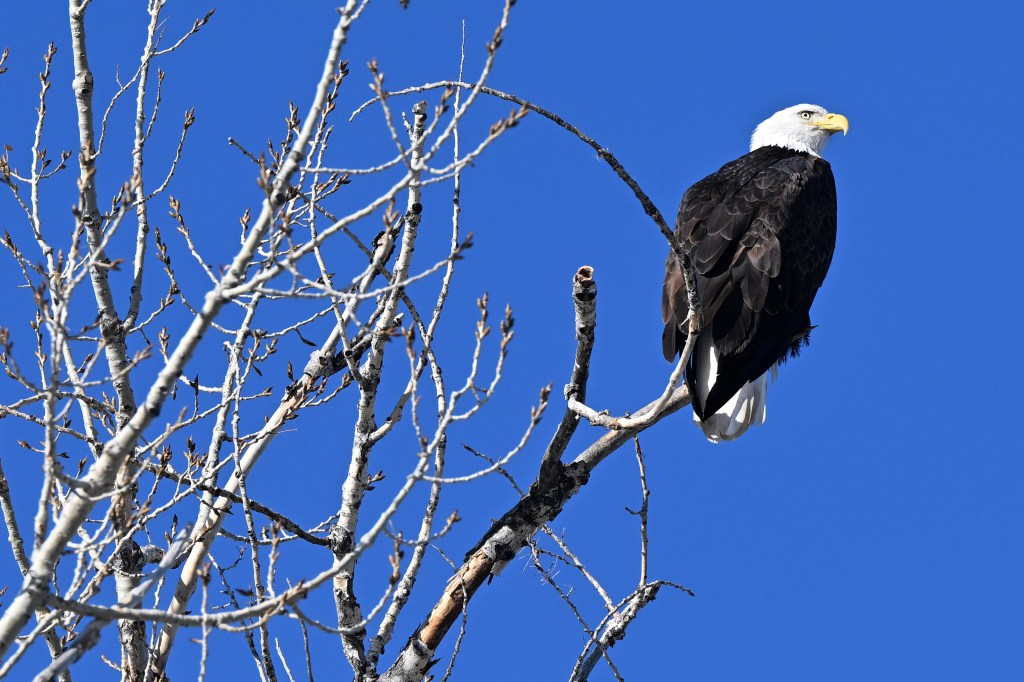
An active bald eagle nest in Boulder County now contains its first egg — laid Feb. 12 — and Xcel Energy is seeking authorization to immediately remove the partially fallen former nest tree just a few meters away. We know this because we are Front Range Nesting Bald Eagle Studies (FRNBES), a Boulder County 501(c)(3) that has studied this nest for years.
The former nest tree supported the Erie Lake bald eagle nest for the past two seasons. In August 2025, it blew down to roughly a 45-degree angle, coming to rest near primary electrical lines in a rural agricultural enclave near Lafayette. The eagles built a new nest very close by. Because of the leaning tree’s proximity to the lines, we immediately notified Colorado Parks and Wildlife (CPW) and Xcel Energy.
At that time, there were no eggs, no incubation and no dependent young. There was a clear window for evaluation and, if necessary, mitigation outside the breeding season.
Over the following months, our group remained in contact with Xcel’s contractor and CPW. We provided full-day monitoring data identifying consistent midday windows when the adult eagles were away from the nest to minimize disturbance if work was required. In November, after no action had been taken, we proposed independent drone-based 3D modeling by a third-party engineering firm to objectively determine whether the leaning tree posed a true contact hazard to energized lines — and we offered to cover the cost. That modeling was never completed.
Now, with incubation underway and CPW’s seasonal nest protections in effect, Xcel has left notice at the homeowner’s door requesting authorization to remove the downed tree and an adjacent tree immediately. The former nest tree stands only meters from the current active nest. The timing could not be worse for this new eagle family.
The issue is not whether utilities have safety responsibilities. It is why hazard evaluation did not occur during the six-month period when it could have been conducted without risking disturbance to an active nest.
Today, an egg is in that nest. Any extended chainsaw work and heavy activity within a few meters during incubation carries a real risk of nest abandonment. There was a window to assess risk and to document hazard outside the breeding season. That opportunity passed without action.
With an egg in the nest, the margin for error is gone.
Bald eagles are federally protected under the Bald and Golden Eagle Protection Act. The bald eagle is more than a protected species; it is a symbol of this nation and of the conservation success that careful management can achieve. Federal protections exist for a reason, and they are meant to be applied thoughtfully and consistently — especially during active breeding.
Even in complicated situations, adherence to clear standards, coordinated planning and respect for established wildlife protections should not be optional. The leaning tree was identified in August. The breeding season was predictable. The current timing was not inevitable — it was the result of delay.
Timing matters. So do the values our nation’s eagle protections represent.
Dana Bove is the founder of Front Range Nesting Bald Eagle Studies, a nonprofit conducting long-term research on raptors and habitat conservation throughout the northern Front Range.
