


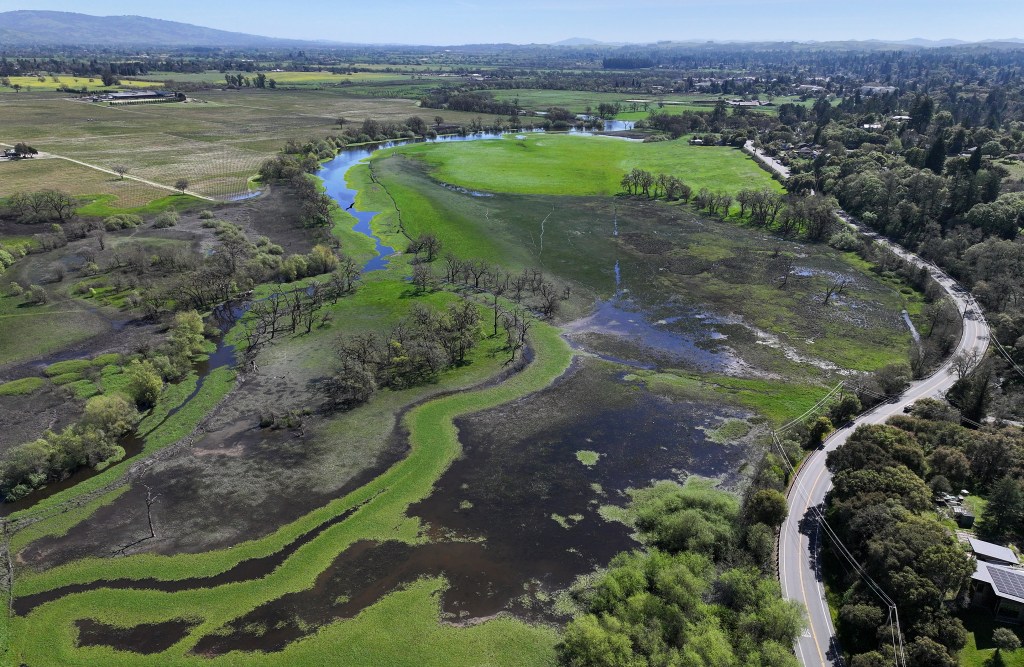

A stretch of farmland along the Laguna de Santa Rosa floodplain could become a new home for steelhead, coho salmon and wading birds as part of a major wetland restoration effort now backed by more than $1 million in state funding.
The Laguna de Santa Rosa Foundation was awarded a $1.05 million grant in late February from the California Wildlife Conservation Board to begin planning restoring 175 acres of farmland between Sebastopol and Forestville back into riparian and wetland habitats.
The grant marks a major turning point for the foundation, which will now be able to take on its largest singular project in the foundation’s 37-year history.
The site sits along the laguna just north of Gravenstein Highway on land once owned by the Lafranchi family ranch, a property that has been farmed for multiple generations. In 2024, Sonoma County Ag + Open Space purchased a conservation easement on a portion of the ranch to ensure it would be permanently protected.
The state funding will cover the costs of the design work, which includes environmental and hydrology studies, engineering plans and habitat assessments.
The engineering will be done by PCI Ecological, a Sebastopol-based engineering firm. The team hopes to wrap up the planning by the end of 2028, said the foundation’s Executive Director Anne Morkill.
Early discussions about the design includes carving out new stream channels through the property and replanting native plants and vegetation that can withstand seasonal flooding.
Morkill says the foundation is working with a “consortium of stakeholders” on the project including Sonoma Water, the San Francisco Estuary Institute and the Federated Indians of Graton Rancheria.
With this project, “the concept is to put back these natural habitats and that comes with a kind of cascading effect,” Morkill said. “Healthy aquatic invertebrates help feed native fish and wading birds.”
Both coho and steelhead are known to travel through the region’s tributary creeks, Morkill said, adding that both species have been known to use floodplains like this as a nursery before heading to the Russian River.
Not only would this project support critical fish habitats, but it is also essential for providing a wider environment for mammals such as deer, bobcats and river otters, she added.
If it moves forward as planned, Morkill said the project represents a unique opportunity that most urban areas don’t have for restoring wetlands to retain their natural beauty and replenish ground water resources that people rely on.
“There are a whole host of different benefits that can be realized by having a healthy laguna — not just for fish and wildlife, but for people too,” she said.
The Laguna de Santa Rosa stretches 22 miles throughout the county and is the largest watershed feeding into the Russian River.
Since its founding in 1989, the foundation has tackled numerous smaller-scale projects to address declining water quality and habitat loss along the floodplain, Morkill said.
