



In Patricia Highsmith’s unnerving 1964 short story “The Snail-Watcher,” a broker’s quiet fascination with breeding garden snails curdles into a terrifying biological reckoning that ends with him entombed by his own neglected and ever-multiplying subjects. The tale, a claustrophobic master class in the hubris of human interference, offers a bleak twist on the frailty of humanity’s supposed dominion over nature.
“The Snail-Watcher” finds a startling real-world echo in French Polynesia, where well-meaning ecological interventions have backfired with catastrophic precision. During the 1980s, Partula snails, a genus of aspirin-size tree mollusks with more than 100 species and subspecies across the Society Islands of French Polynesia, nearly vanished after the arrival of a carnivorous foreign snail. (That snail had been introduced a decade earlier in an attempt to control a different invasive snail.)
Partula is re-establishing its place in Pacific ecosystems because of a pioneering rescue initiative that began in 1991 and now includes 15 zoos around the world. Led by the Zoological Society of London, the alliance focuses on captive breeding and reintroduction. Recently, more than 7,000 Partulas of various critically endangered species and subspecies were introduced across four French Polynesian islands — the largest undertaking of its kind.
Snails have been both protagonists and antagonists in the islands’ modern history. “Meddling humans have engineered quick fixes without fully grasping the chaotic, long-term repercussions,” said Paul Pearce-Kelly, the curator of invertebrates and fish at the Zoological Society. And Partulas hold immense research value, despite their small size. “They’re the Darwin’s finches of the snail world,” Dr. Pearce-Kelly said. “They have been under scientific scrutiny for more than a century, offering a unique, real-time look at how isolation drives evolution.”
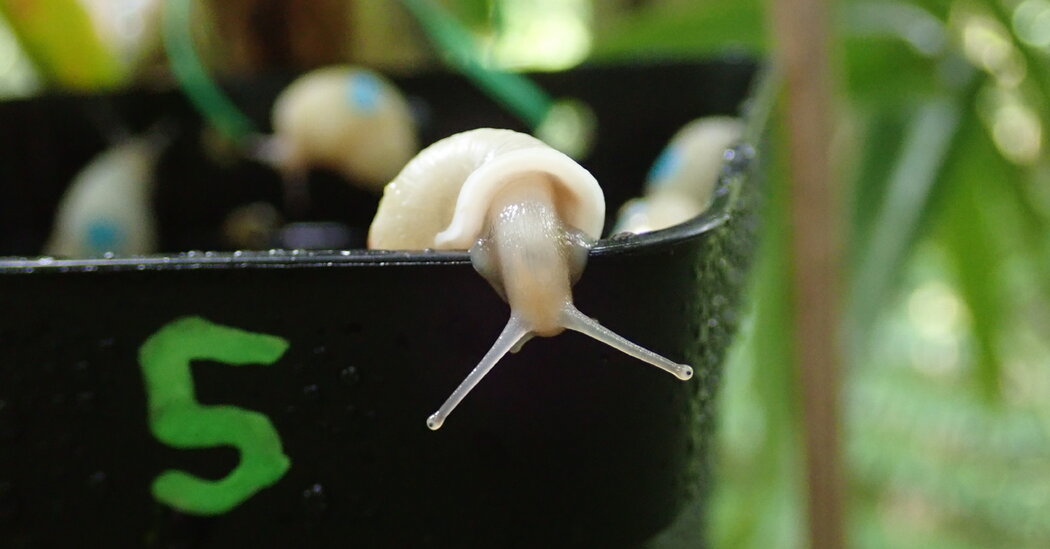
Thirty-five years ago, a colleague of Dr. Pearce-Kelly rescued the nine last-known members of Partula tohiveana, a species commonly known as the Mo’orean viviparous tree snail, which led to the Zoological Society’s conservation effort. To date, the organization and its partners have returned more than 30,000 snails to Mo’orea, Tahiti and other Pacific islands, including 11 species and subspecies once considered extinct in the wild, into predator-proof reserves. Before release, and to aid monitoring, each snail’s shell is dabbed with fluorescent paint that glows blue under ultraviolet light.
Timothy Pearce, head of the mollusks section at the Carnegie Museum of Natural History in Pittsburgh, described the program as a critical model for mitigating human impact on fragile island biodiversity. Decades of intensive conservation paid off two years ago with the discovery of wild-born Partula tohiveana on Mo’orea; the species was once deemed lost. This success was closely followed by the discovery of a wild-born Partula varia on Huahine, the first time in three decades that the rare snails had naturally repopulated their native habitats.
Thank you for your patience while we verify access. If you are in Reader mode please exit and log into your Times account, or subscribe for all of The Times.
Thank you for your patience while we verify access.
Already a subscriber? Log in.
Want all of The Times? Subscribe.
