



Despite being the template of what hardcore action RPG’s once were before From Software got their time in the limelight, Monster Hunter has found ways to make the series accessible to all types of gamers. Perhaps the most famous of their franchise spin-offs is the Stories series, a title intended for younger audiences, more focused on hatching and raising monsters to battle alongside you. Now the third entry in the series, Monster Hunter Stories 3: Wicked Reflection doubles down on the single-player experience and delivers a campaign more focused on monstie conservation.
Monster Hunter Stories 3: Wicked Reflection focuses more on a darker narrative than its perhaps more lighthearted prequels. With two neighboring countries at a tumultuous standoff alongside the encroachment of a mysterious environmental force known as crystallization, something so small as the spark of a Rathalos’ fire breath could set off full-scale war in the region. While one country is focused on living with monsters in harmony, the other uses them as tools for war and invasion to stake out new land for their citizens to live in, as the crystallization and barren wastelands slowly consume any patch of livable land and stomp out any hope of survival.
At the center of the narrative are a pair of Rathalos, each adorned with a crystal horn, who were sentenced to death immediately after hatching due to their twin nature being considered an ill omen. While one escapes and is presumed lost for most of the player’s young life, the other remains his lifelong companion and remains the one monster you’ll keep in your battle party from beginning to end. Along the journey, players will travel across a variety of regions, both seeing the aftereffects of the crystallization catastrophe and also the resilience of humans, Wyverians, and monsters alike to survive in these conditions.
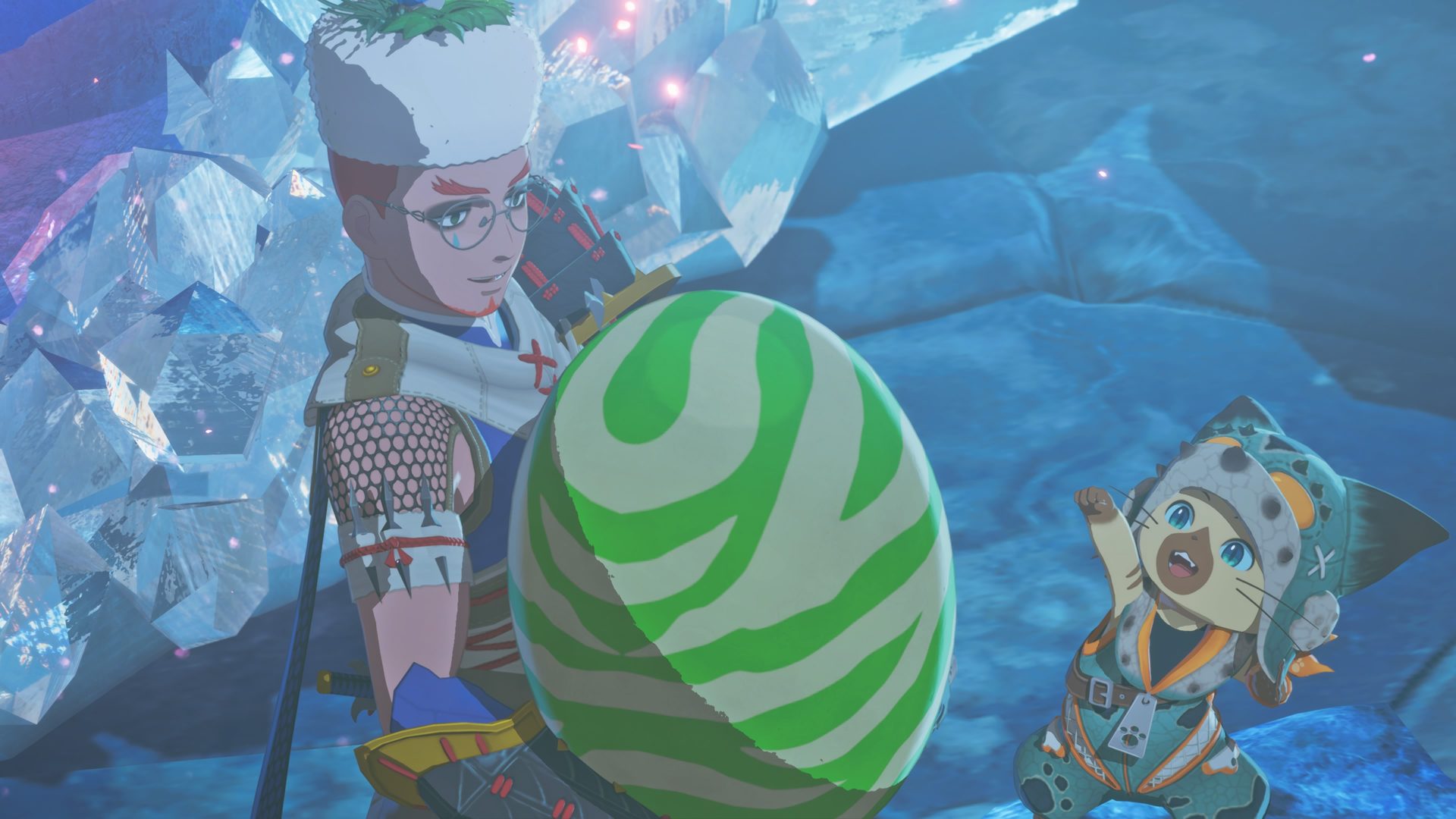
Part of what makes the Stories series such a unique take on Monster Hunter is the monster-battling and collecting aspect of the various monsters around the land. Recruiting a monstie into your party isn’t as simple as throwing a paintball at it and hoping for the best. Instead, it’s about finding eggs scattered throughout the world and hatching them back at the base camp as companions for your party (the hero can bring six different monsters into battle while the AI party members are each limited to one signature beast). Occasionally, upon beating a monster, it will retreat to its den (with an increased chance if you mark them with paintballs first), where you may find one or two eggs of that monster type, but more often than not, you’ll simply find dens scattered across the land featuring an assortment of eggs for the monsters in that particular biome.
Gathering up more eggs than you’ll know what to do with is what feeds into Monster Hunter Stories 3’s primary progression loop. While you could stick with a single monster in your party, that’s actually limiting the potential of that particular monster. Stories 3 is all about conservation and bringing what once were endangered or even thought to be extinct monsters back into a flourishing environment. Each biome of the game’s four regions is separated by both base element and an assortment of five different monsters that call that habitat home. Players can then introduce up to five other monsters through the additional restoration slots. By donating enough eggs to a particular region, monsters that hatch from eggs acquired in that region take on a number of notable transformations, one being additional skills imbued from birth based on that particular environment in which they were raised, but more intriguingly, can give each monster a completely unique element. Want to raise a Plesioth to sail the seas but also give it Thunder attacks to make up for its most glaring elemental weakness? How about a Bloodbath Diablos with Dragon element attacks to make it even more imposing?
There’s also a unique puzzle mechanic to strategically introduce certain monsters in a region in order to help force a mutation in the existing wildlife. Players can encounter rare subspecies by listening in to NPC chatter or picking up monster tracks in an obvious nod to the tracking mechanics Monster Hunter World introduced to the series. Increasing the ecosystem rank of a specific monster (by donating enough eggs in that region) and introducing it into a habitat filled with specific species can force an evolutionary change and introduce a brand new subspecies of monster for a handful of monsters. The first subspecies player might encounter dynamically in their adventure is the Dreadqueen Rathian, first transformed by introducing Rathian into a habitat containing three or more poisonous monsters.
Combat in Monster Hunter Stories 3 returns to the turn-based affair of its predecessors with a few new twists. A stamina system is at the core of both the player and companion monster’s movelist, with certain monsters offering a higher initial stamina but perhaps a lower regeneration per turn. Sometimes it’s not enough to just beat the monster at the rock-paper-scissors mechanic of matching Power, Speed, and Technique attacks (you’ll want to keep a notepad on hand to remember what attacks a monster does both in regular combat and also when it’s enraged), but also holding back the big game-ending attacks until an enemy monster is stunned or otherwise open for attack. Riding mechanics are also brought back as a special, powered-up attack with unique synchronized attacks available for every monster and party companion.
While the narrative to Monster Hunter Stories 3 will get its hooks into the player in both the beginning setup and world-changing epilogue, the forty-some hours in between are where the story drags on. Much of the narrative falls by the wayside, and a sense of urgency is lost as players double down on habitat conservation and the seemingly endless clutter of sidequests around the world. Each of the player’s companions offers their own series of quests that do offer some permanent unlocks, including ways to make it easier to track down the hundred Poogies scattered around the world or new recipes to cook and eat at camp. However, they’re a small positive to counterbalance the glut of by-the-numbers side quests that often force the player to gather a specific material or fend off a specific monster out in the world. Thea’s series of sidequests at least offered a break in the usual action by challenging Ratha into a series of races against speedy Poogies.
So much of the nearly-sixty hours I spent in Azuria and beyond was spent performing a series of repeatable and often mind-numbing tasks of harvesting eggs, raising them up in regions where I thought could benefit from a new apex predator, or perhaps experimenting in the elemental subtypes and unlocking different subspecies that I felt somewhat defeated by the time the end credits rolled. True to Monster Hunter’s nature, extra challenges are available to the player, including squaring off against Elder Dragons, whom players might have only encountered briefly and tried to scare off during the normal course of the story (rewarding the player with materials for some of the strongest weapons and armor in the land). While there is a definite narrative throughline for Monster Hunter Stories 3: Twisted Reflection, the game rewards and often expects the player to stop and instead focus on environmental conservation efforts.
[Editor’s Note: Monster Hunter Stories 3: Twisted Reflection was reviewed on the PlayStation 5 Pro. Review code was provided by the publisher.]
You can find additional information about our standard review process and ethics policy here.
8.6
WCCFTECH RATING
Monster Hunter Stories 3: Twisted Reflection
With a much more serious and ominous narrative this time around, Monster Hunter Stories 3 manages to balancing the joy of hugging your Poogie with the challenge of besting an Elder Dragon in manual combat.
Pros
Cel-shaded character designs provide a vibrant backdrop to the stark, often apocalyptic landscape
Set two hundred years after the previous title with a player character than can finally speak for himself (although his Palico still does most of the talking)
Mix-and-match monster genes and elements to create some uniquely dangerous monsters
One hundred Poogies
Combat system that rewards preparation and memorizing enemy patterns
Challenging at every step of the way with some devilish endgame bosses to discover
Instantly slay monsters you outlevel and still get the experience and rewards
Cons
Narrative falls flat for the middle 50% while the player Hunter focuses on restoring the local wildlife
Core loop of gathering eggs, raising monsters, and sending them off to repopulate the world becomes a chore some twenty-hours in
No way to automatically track a monster’s particular type of attack
Invasive monsters that must be repelled are a poorly executed puzzle mechanic
Buy for $69.99 from Amazon The links above are affiliate links. As an Amazon Associate, Wccftech.com may earn from qualifying purchases.
