


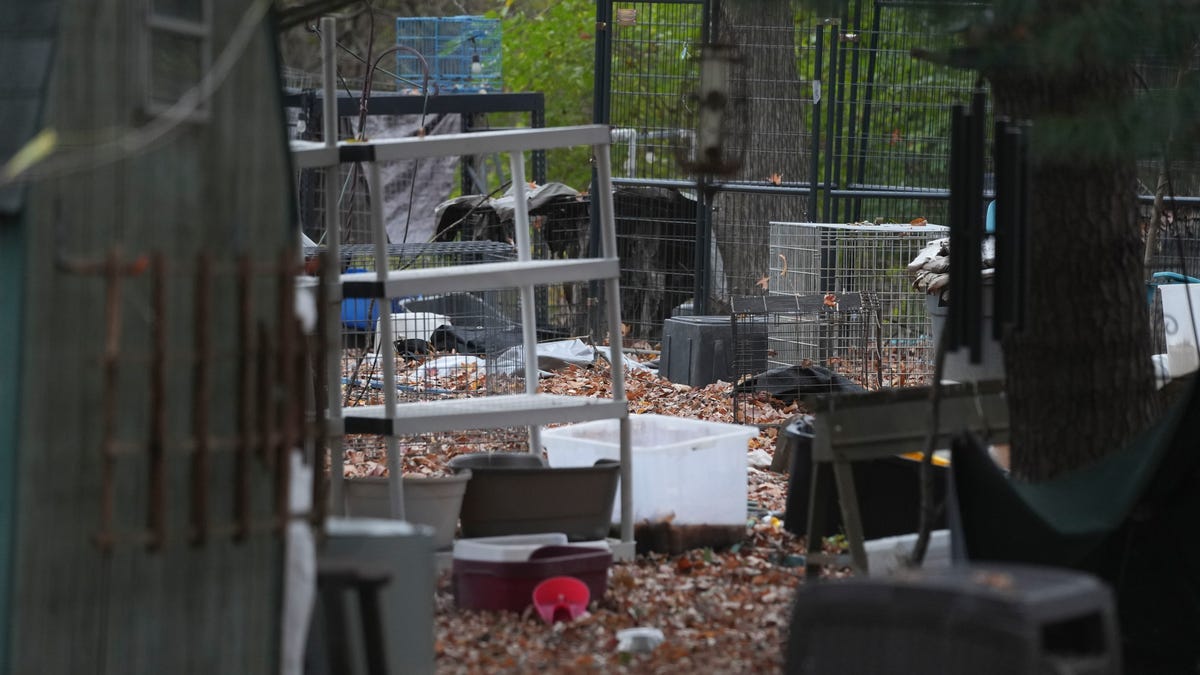

A Delaware Chancery Court magistrate has issued an opinion in a five-year-long squatter’s rights feud among neighbors over a backyard-oasis-turned-animal-sanctuary that was the site of one of the largest animal welfare raids in state history last year.
In September, state agents swarmed the townhome and backyard of a nonprofit animal shelter founder named Mark Ptomey, seizing nearly 100 animals they claimed were living in various states of malnutrition and squalor.
The highly publicized raid was preceded by a yearslong legal feud between Ptomey and his neighbors over his expanded, fenced-in backyard that dwarfs neighbors’ yards and encroached on neighborhood common space in the tucked-away, treelined cul-de-sac known as Stonebridge Townhomes near New Castle.
Years before the raid and before the property was serving as an animal shelter, the feud had been simmering in passive-aggressive neighborly sniping before eventually reaching Delaware’s famed Court of Chancery, where the neighborhood’s homeowner association asked a court to mandate Ptomey retrench his backyard back to the original property line.
In depth: How neighborly feud led to seizure of nearly 100 animals from townhome
Ptomey, representing himself, litigated the case for years by asserting a claim to the land under Delaware’s version of squatter’s rights. He leaned on his own childhood memories, scrapbook Polaroids, historic Google Earth satellite imagery and family lore to argue the judge should give him title to portions of his backyard that sit on common ground.
However, after months of deliberation after an October trial, Chancery Senior Magistrate Selena E. Molina last week issued her opinion in favor of the homeowner’s association, ruling that Ptomey should be forced to remove fencing and other items from the expanded portion of his backyard.
Ptomey and attorneys for the homeowner’s association did not respond to requests for interviews. The ruling must be approved by a separate judge in Chancery and is pending potential appeals.
Meanwhile, Ptomey is due back in a separate Delaware court later this month to defend against some 200 animal welfare misdemeanors and violations tied to the September raid.
The raid: 98 dogs, cats and other animals seized from New Castle home of animal rescue president
He has denied the charges and in court filings, has accused his neighbors of colluding with county code enforcement and state animal welfare officials to orchestrate the highly publicized crackdown on his sanctuary nonprofit in order to “harass,” “intimidate” and “defame” him.
How we got here
Ptomey’s claim to the land dates back to 1992 when his aunt, Mary Elizabeth-Kuhn, purchased her townhome in Stonebridge. In her backyard, she built what witnesses described as a beautiful and carefully maintained herb and flower garden. It included a shed, walkways of red stone pavers and fencing.
It also expanded beyond her property line onto common space that is owned by the community and that neighborhood rules mandate must be available for the use of everyone. Neighbors told the court they paid little mind to the encroachment and part of the purpose of her backyard work was to alleviate drainage issues.
Kuhn died in 2015, and Ptomey began renting the property from her estate before formally purchasing it alongside his mother, Kuhn’s sister, in 2017. He told the court he simply maintained and repaired the expansive backyard as his aunt did for years.
Neighbors testifying in court accused Ptomey of expanding the garden’s footprint, pouring an expanded patio, adding higher and more intrusive fencing and regularly hauling in dirt and rock in contravention of neighborhood rules.
It’s undisputed that animal sanctuary operations came years later, long after neighbors began complaining about his work in the backyard and teed up the Chancery showdown over the backyard boundaries.
What the court ruling determined
The homeowner’s association argued that Ptomey’s continued use of the expanded backyard amounted to trespass and asked the judge to order him to draw back the yard. He argued that the expanded footprint onto association common ground should be legally his under what’s known as adverse possession.
That law allows a person to take ownership of another’s property if they’ve used it for at least two decades in a way they can demonstrate is “open, notorious, adverse, exclusive and hostile.” The issue at trial was convincing the judge it was more likely than not that Ptomey’s use fit those parameters based on evidence presented in court.
To argue his possession met the time burden, Ptomey argued his aunt’s expanded use of the property dated back more than two decades, was obvious to everyone, well known in the neighborhood, against the rules and exclusive to her benefit and that he simply continued it.
However, witnesses from the homeowners’ association testified that they recalled Ptomey’s aunt saying that she was granted permission by association officials and developers to begin modifying the backyard to fix drainage issues.
Molina, the judge, ruled that testimony was more convincing than Ptomey’s. She opined that such permission went against the “hostile and adverse” requirements for him to claim adverse possession and reset the clock to when he took possession of the property less than a decade ago.
She also noted he expanded the footprint of his aunt’s use of the property in a way that also reset the timer.
What now?
Ruling against the adverse possession motion, Molina then opined that Ptomey was trespassing on community common ground. She wrote he should be required to remove any property from the common area and pay any costs for the homeowners’ association to return the space to its “natural condition.”
She declined to assess the homeowners’ associations’ legal fees to Ptomey.
The ruling is pending final approval and may be appealed to the state’s Supreme Court.
Meanwhile, the issue of the animals that were sheltered in the backyard is still percolating in multiple courts. Earlier this year, Ptomey filed suit in Delaware’s federal court seeking an injunction to stop the Brandywine Valley SPCA from continuing to adopt-out animals seized in the raid.
Ongoing litigation: Animal rescue director whose home was raided sues Delaware officials
He also sued state officials, claiming a requirement that he pay a boarding fee for the seized animals is unconstitutional. He claims he is required to pay a $475 “ransom” every 15 days for each animal seized or the animals are forfeited to the state or Brandywine SPCA.
Those lawsuits are in very early stages.
Additionally, he is due for a potential jury trial in Delaware’s Court of Common Pleas over the nearly 200 animal welfare misdemeanors and violations from the raid − charges he said are false.
In correspondence to Delaware Online/The News Journal before the raid, Ptomey wrote that his nonprofit’s mission is to provide second chances to animals turned away or that would be killed by other shelters. The correspondence gives some insight into what Ptomey was thinking with some 100 animals living in the community of connected townhomes.
He said at the time that any mess associated with the animals was temporary, not neglect, and was the reality of caring for dozens of animals
