

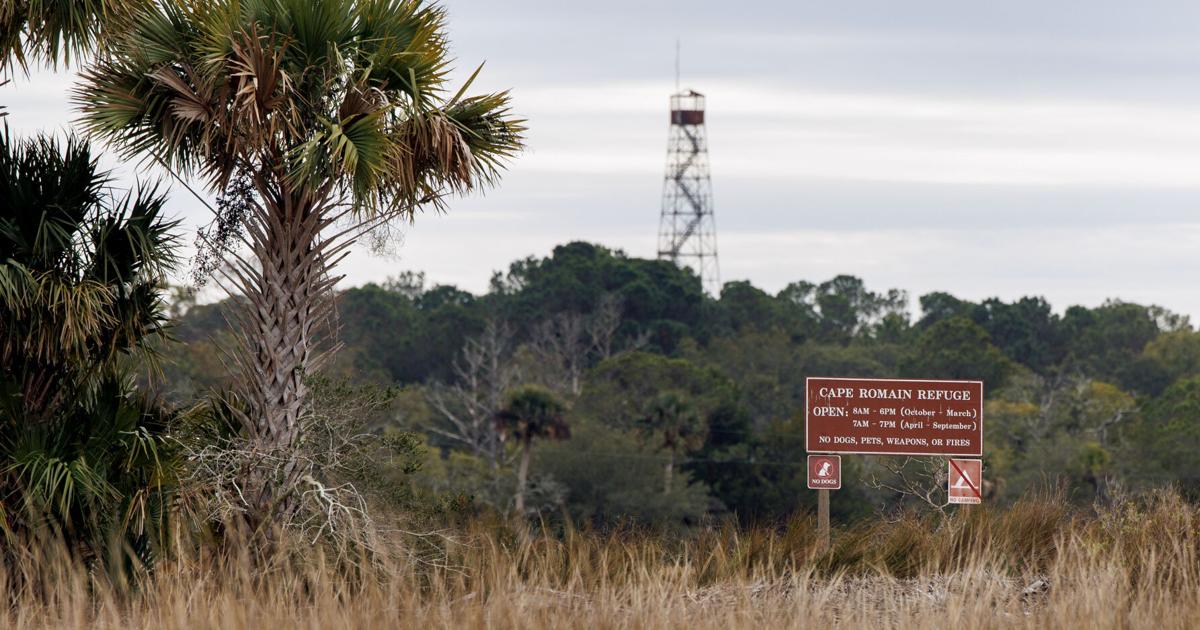

AWENDAW — Drive north on U.S. Highway 17, past the shopping centers and subdivisions, and you’ll come to a small town that sits at the proverbial crossroads of South Carolina’s most-pressing environmental issues. Here the Milky Way still shines at night, the wetlands teem with life, and the trees grow dense enough to create a near-perpetual dusk in the forest below.
But as Charleston County is reshaped by a fast-growing population and rising seas, the future of Awendaw and its wild spaces is in an uneasy limbo, and there’s no easy path towards a solution.
In this small town, anxieties about over-development collide with increased flooding, leaky septic tanks and the threat of wildfires. All of those issues are playing out in a town wedged between two of South Carolina’s most-diverse ecosystems: the Francis Marion National Forest and Cape Romain National Wildlife Refuge.
The Post and Courier’s Rising Waters Lab focuses on impacts of climate change and related policies and practices. It is supported by donations and grants to the nonprofit Public Service and Investigative Fund, whose contributors are subject to the same coverage we apply to everyone else. For more information and to make a donation, go to postandcourierfund.com.
To sign up for our newsletter, click here.
As the U.S. government changes the playbook for federal land management — the Trump administration plans to increase logging in Francis Marion and has cut federal positions across South Carolina — Awendaw is literally caught in the middle.
“We’ve got the Department of Agriculture on the west, the Department of Interior on the east, and this oddly-shaped town of Awendaw is the gateway between those two,” said recently-elected Mayor Chris Crolley.
Awendaw’s adaptation strategy largely depends on nature-based, green solutions and ordinance overhauls, he said. The town recently became the second community in South Carolina to adopt a local wetlands protection ordinance in response to the Trump administration’s plan to deregulate previously-protected areas.
In Awendaw, Blake Scott sees a developing “road map” for other communities.
“ I see Awendaw as a perfect example of conservation on the human scale,” said Scott, the co-founder of the Charleston-based M.A.R.S.H. Project, a grassroots conservation group that works to protect Charleston’s salt marshes. Scott noted that Awendaw, population 1,600, is about the same size as many of Charleston’s neighborhoods.
“ We see that as a functional scale for us to achieve environmental victories,” Scott continued. “If Awendaw can do it, we hope that we could do it at our neighborhood level and then mushroom out from there to Charleston’s various neighborhoods.”
Cape Romain’s gateway
Spanning 22 miles and roughly 66,000 acres, the Cape Romain National Wildlife Refuge is a near-pristine ecosystem of wetlands, islands, shores and maritime forests. The Cape is a biodiversity hotspot home to the state’s most-active nesting sites for loggerhead sea turtles and nearly 300 migratory and year-round bird species, several of which are considered
