


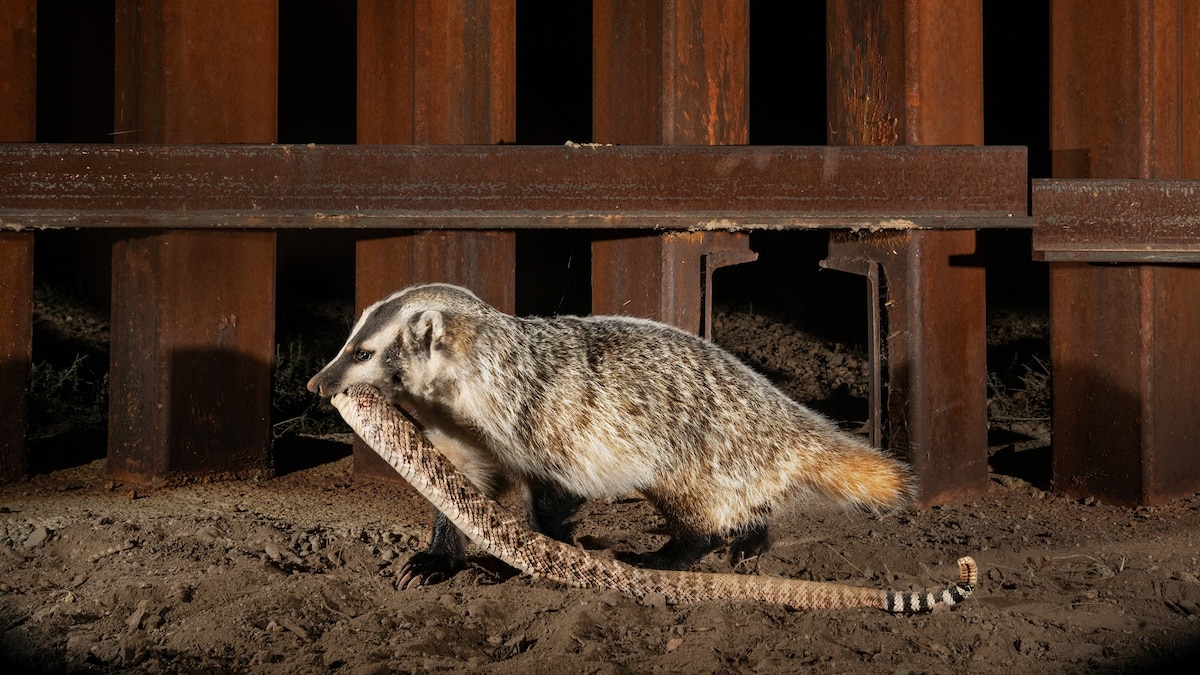

In the rugged terrain where Mexico and the United States meet, a border wall is just the latest obstacle fragmenting habitats and disrupting migration paths. Here’s how a cadre of conservationists is trying to get animals moving.
A rattlesnake-toting badger walks beside the steel-slatted wall being built along the border between the United States and Mexico. The wall disrupts animals’ movements in profound ways, but for those small enough, sporadic narrow openings offer passage.
Photographs byJaime Rojo
Text byBrian Kevin
January 8, 2026
To appreciate how the Madrean Sky Islands earn their nickname, it helps to imagine the hawk’s-eye view. Looking down over the borderlands that stretch out across Arizona, New Mexico, and the Mexican states of Sonora and Chihuahua, you would see a wide swath of desert scattered with more than 50 small, rugged mountain ranges: an archipelago of green on either side of the international border.
These high-country oases help make the Sky Islands region one of the world’s most spectacularly biodiverse, a place where a fleet-footed mammal might wander among five different biomes in a day, from dusty desert scrub to lush pine and fir forests. And for millennia, wild creatures of all sorts—javelinas and pronghorn, coyotes and ocelots, black bears and jaguars—have moved across this land by following the ridgelines and waterways, a network of cool, wet corridors where vegetation thrives. From above, it’s easy to trace these timeworn routes, green ribbons against the tawny earth.
You would also notice intrusions. Roads and highways. Irrigated farm fields. Ranch fences stretched across rangelands where grazing and erosion have stripped the soil. And along the international border, the patchy black line of an immense wall, some 250 miles of which have been built through the heart of the Sky Islands since 2017.
All of these are potential interruptions to the ancient arteries that lead animals through the borderlands—routes that photographer and National Geographic Explorer Jaime Rojo knows well. A former project director for a Mexican conservation organization, Rojo has spent the past two years documenting the myriad ways that human development fragments wildlife habitat in the Sky Islands, disrupting animals’ annual and seasonal movements and hindering access to food, water, and mates.
Along the way, Rojo has also seen firsthand how a remarkable coalition is working on both sides of the border to preserve and restore the region’s ecological integrity. It’s a group that includes scientists monitoring the limited wildlife passages in the border wall, private ranchers reintroducing native plants and animals to their lands, and Indigenous leaders reclaiming stewardship of sacred and ancestral territory.
Among the defenders are pioneers like Valer Clark, 85-year-old founder of the nonprofit Cuenca los Ojos, who has spent decades stacking rocks in dusty washes, repairing streambeds, and restoring vegetation on erosion-scarred ranchlands. Also researchers like National Geographic Explorer Ganesh Marín, who has logged countless backcountry miles installing motion-sensing wildlife cameras and gathering vital data about the movement patterns of animals like black bears, javelinas, and elusive jaguars.
1 of 8
Smaller animals might pass through the border wall using openings, about the size of a standard sheet of paper, that some have likened to doggie doors. Border officials say more than 50 such openings were installed across Arizona between 2017 and 2020, with more added since. Eamon Harrity, who monitors wildlife crossings for the Sky Island Alliance, says his organization counts 30 along some 150 miles of border in the Sky Islands region. Desert travelers photographed using doggie doors on Cuenca los Ojos lands include (in the order above) raccoons, rats, skunks, javelinas, gray foxes, bobcats, mountain lions, and coyotes. Camera traps were placed with assistance from Sky Island Alliance.
“They are all pragmatic and realistic,” Rojo says, “and their common thread is that they are all in love with the Sky Islands.”
Today, as construction continues on a border wall that already bisects much of the region, many of these partners find themselves more separated than ever—and seeking new ways to collaborate to ensure some of the continent’s oldest animal migrations don’t vanish completely.
A version of this story appears in the February 2026 issue of National Geographic magazine.
The nonprofit National Geographic Society, committed to illuminating and protecting the wonder of our world, funded the work of National Geographic Explorers Jaime Rojo and Ganesh Marín featured in this story. Learn more about the Society’s support of Explorers.
Sale Extended – Save up to $20!
PLUS, for a limited time, get bonus gifts and issues with all Nat Geo subscriptions.
