



Gardeners and preservationists are working together to transform forgotten burial grounds into “living memorials” that combine remembrance with biodiversity and community engagement.
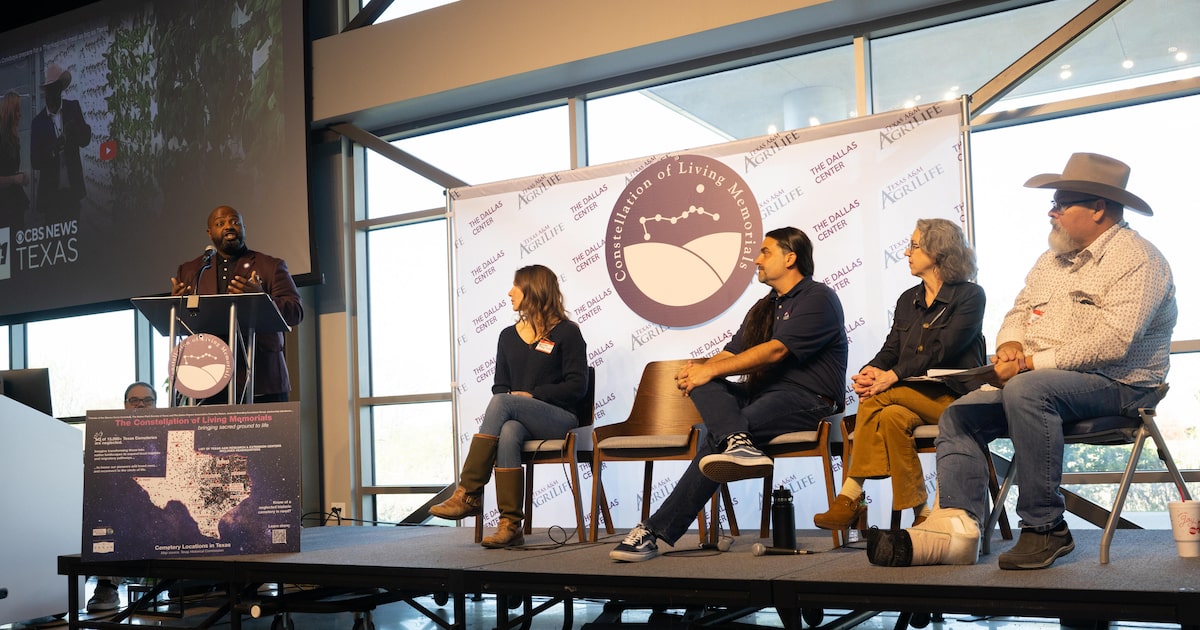
The inaugural Constellation of Living Memorials Symposium, a day-long event that took place this month, brought together stakeholders to discuss reimagining neglected historic cemeteries and the connection between conservation and environmental challenges in the region.
Related
The symposium was hosted in partnership with Texas A&M AgriLife Extension.
“We need to honor, remember and not lose our connection to the land,” said Chris Shropshire, a special assistant to Michael J. Sorrell, the president of Paul Quinn College, during a panel conversation.
The event began with a screening of “Building Constellations,” a short documentary that chronicles the two-year pilot of the Constellation of Living Memorials initiative. The film set the stage for discussions on how local volunteers have restored cemeteries across North Texas.
It all started with Julie Fineman, a master naturalist who transformed the 19th-century Warren Ferris Cemetery near her East Dallas home into a wildlife refuge. She recruited neighbors, who cleared the dense, non-native plants covering the graves and began restoring the ground to its original Blackland Prairie.
Today, seven cemeteries in Dallas are part of the organization’s program.
Another panel discussion focused on how local organizations are working with the youth to educate them on native plant propagation. Representatives from Paul Quinn College, the Native Plant Society of Texas and local nonprofits highlighted new training programs and greenhouse capacity that supply restoration projects with regionally adapted species.
Jonathan Soukup, a second-generation nurseryman and manager at Southwest Perennials, a 90-year-old greenhouse supplier of seedlings across the state, located in southern Dallas, said exposing young people to horticulture and conservation builds long-term stewardship.
“In an ‘Amazon era’ when we want everything to get to our door by the next morning, it’s important to teach our kids and youth that nature doesn’t work that way,” Soukup said.
Attendees had the opportunity to tour the university building and learn about its water irrigation and conservation system, led by Fouad Jaber, a professor and integrated water resources management extension specialist with the Biological and Agricultural Engineering Department at Texas A&M AgriLife Extension.
“Constellation of Living Memorials is not simply a program; it is a model. A recipe,” said Fineman, co-creator of the project. “A way forward that strengthens community bonds, restores ecological health, honors ancestors and reintegrates humanity with native nature.”
