


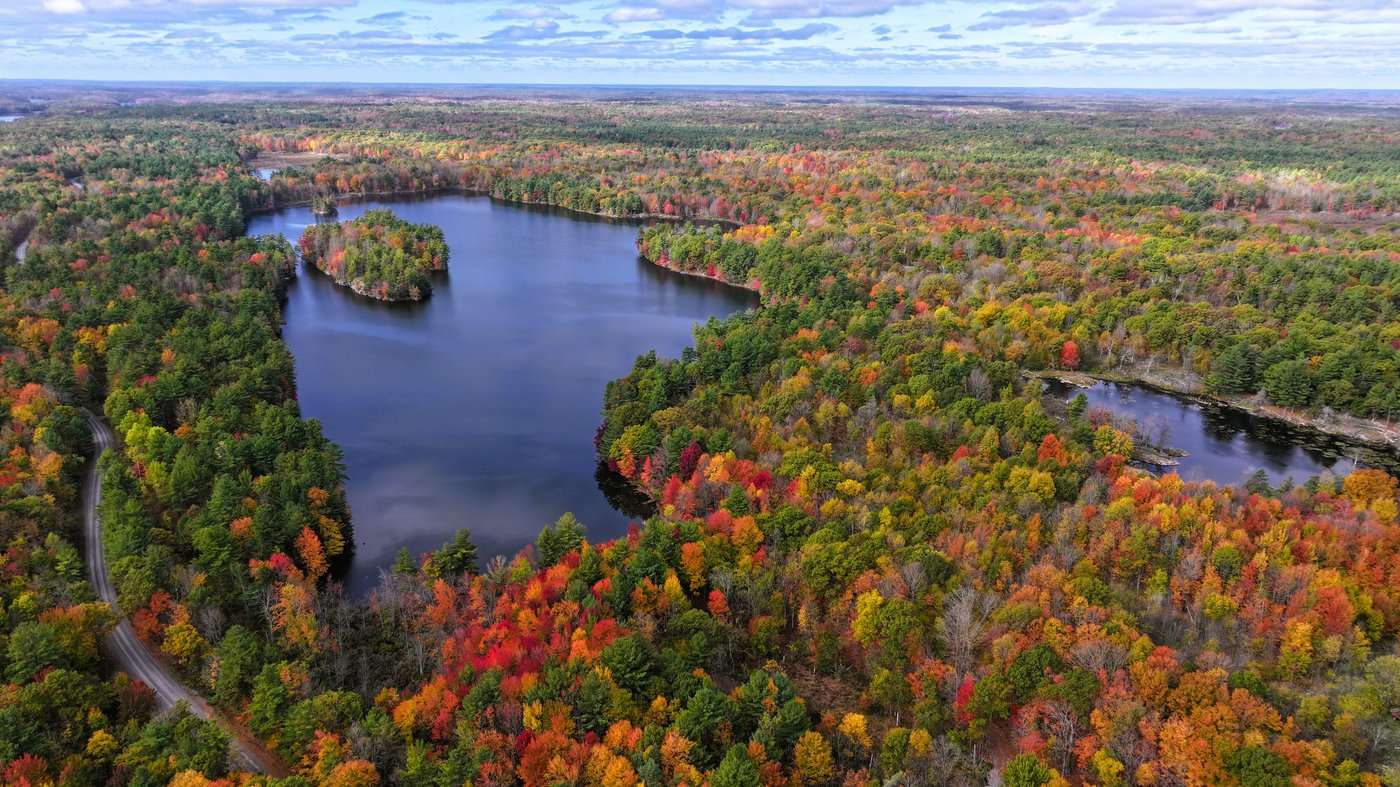

The Nature Conservancy of Canada (NCC) announced on Friday, Nov 14, 2025, that nearly 350 hectares of land in the Frontenac Arch is to officially be considered protected land.
The Frontenac Arch biosphere is considered a UNESCO biosphere reserve, and is a corridor that connects Ontario’s Algonquin Highlands to New York State’s Adirondack Mountain range. Friday’s announcement brings three new sites into the conserved biosphere of Frontenac Arch: Christie Lake, Upper Awada Lake, and a trio of connected parcels in the Loughborough Wilderness area.
The three sites are located near Westport, Perth Road, and Battersea, respectively, and provide habitat for species at risk, such as Blanding’s turtle, gray ratsnake, and eastern whip-poor-will.
Rob McRae, NCC’s Program Director for Eastern Ontario, said that the protected land is an area of incredible biodiversity and is an important connector for allowing life to move north and south. He noted that while it’s a relatively small area in the grand scheme of the vast areas, it is vital in connecting Canada and the United States.
“It’s really important for wildlife,” McRae said.
“This little narrow band of green and blue, kind of between Kingston and Brockville and Westport, is the connection point, the narrow pinch point in that entire corridor.”
The NCC has been in operation in southern Ontario for over 20 years, and has secured 38 different nature reserve projects.
McRae said the NCC has been working on securing these sites in particular for some time, and it required patience, determination, and support from other partners.
“These are the three latest ones in the fleet, and we’ve done so with a lot of support from partners,” McRae said.
“There’s a lot of local partner organizations, our neighbours on the ground. The one property, for example, which took 15 years to come together as a nature reserve. So it’s a long game of patience.”
The conservation of these properties does not mean a hard stop on development in the Frontenac Arch, and there has been support from both the federal and provincial governments in securing these protected sites.
McRae said that the NCC knows that development in the area is also necessary alongside protecting vital sites, and that their work is in large part about finding a balance. The Frontenac Arch, he said, can be a place that integrates nature and people.
“We recognize that there are some areas that are developing, so we kind of look at the larger parcels of land that are still intact as a large area,” McRae said.
“And people love the Frontenac Arch area, and there’s a lot of support for what we’re doing in that respect.”
Now that the land is secured, much of the NCC’s work in the area turns to stewardship, working to maintain the protected areas.
With this most recent announcement in the Frontenac Arch area, over 3,200 hectares have now been conserved by NCC and local partners.
