


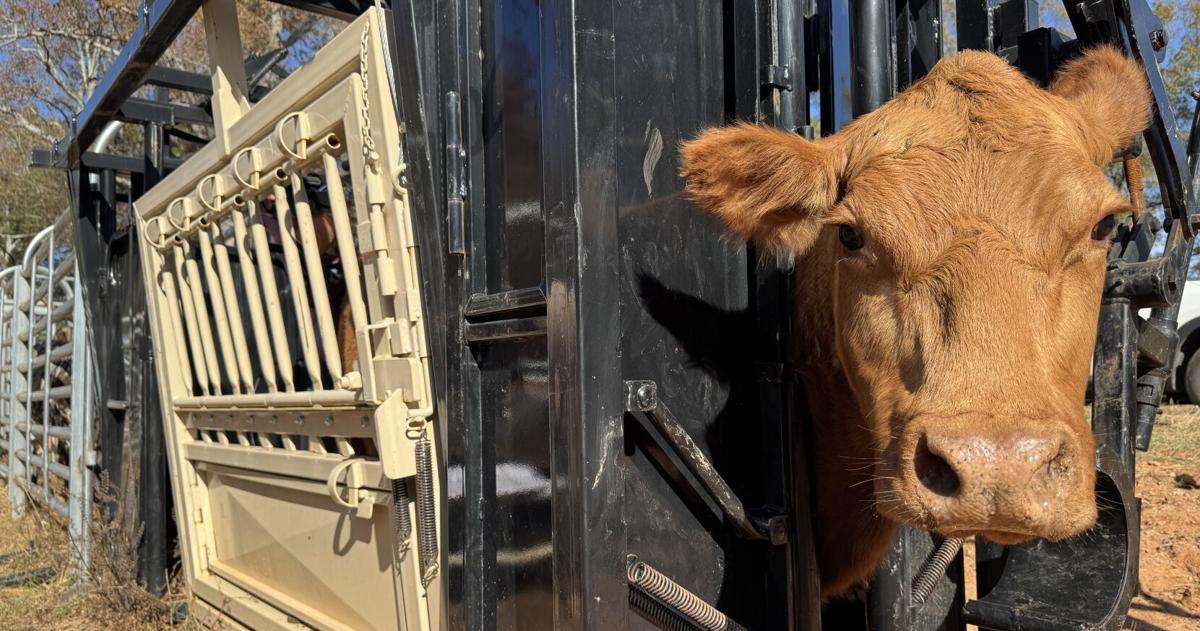

TOWNVILLE – Veterinarian Erika Berr squinted into her visor where an ultrasound image appeared from a probe she’d placed in a pregnant cow. On the fuzzy picture she measured the diameter of the embryo’s eyes.
“One eye is roughly 12 millimeters,” Berr said. “What does that give us for a date?”
Berr’s assistant, Clemson pre-vet graduate Alissa Byars, checked a chart Berr had prepared, showing the relationship between the South Poll baby’s eye size and her development.
“98 days,” Byars said.
“Perfect.”
The pair were checking 22 cattle at Jason Simpson’s 200-acre farm in Townville — work that will stabilize the small herd’s reproductive cycle, keep cows healthy and make the farmer more money in the long run.
South Carolina, following a national trend, has a critical shortage of large-animal veterinarians like Berr, academic, industry and government studies show.
As Clemson University prepares to open the state’s first college of veterinary medicine in fall 2026, lawmakers and university leaders are counting on the new school to make a dent in that problem.
With a special focus on agribusiness and recruitment for underserved rural counties, the school will educate as many as 80 new veterinarians annually by 2030 — but that won’t cover the state’s need for 110 new vets a year going forward, federal data shows.
Still, it will help and optimism is high.
When word got out this fall that Clemson was taking applications for its inaugural vet school class, about 1,700 would-be students responded. More than 1,300 of those applications came the first week, Clemson President Jim Clements told university trustees last month.
The planned school remains under construction and accreditation is pending, but it is already among the most selective in the country, with an acceptance rate that will be below 5 percent this year.
Leaders are banking on the state’s $289 million investment in new and upfitted facilities in Pendleton and an additional $28.4 million in ongoing annual operating costs at full buildout to boost the state’s $51.8 billion agribusiness sector while filling a growing gap in animal care and creating scores of high-paying jobs annually.
A third of the state’s rural counties have fewer than five vets, Clemson’s 2023 proposal for the school reported.
Large-animal care is dirty work with long hours in the field. It requires specialty equipment, a reliable truck, a business plan, good communication skills and years of expensive education — and that’s if you can get into a veterinarian program in the first place.
With vets hard to find, many small farmers like Simpson have gotten used to educating themselves by watching YouTube videos and administering vaccines on their own. But only a vet can spot and treat an infection in a cow’s uterus or identify congenital deformities in a fetus that are incompatible with life, said Berr, whose Country Creatures Veterinary Care is among a tiny number of practices specializing in on-site care at farms.
“If we catch that before a cow is 30 or 60 days bred, we can give her medication to abort that calf and rebreed her for a healthy pregnancy,” Berr said. “Instead of them waiting nine months and getting a calf that doesn’t survive, they get a healthy calf.”
When Clemson’s new vet school is open a year from now, 60 spots in every class will be reserved for South Carolina residents, immediately increasing the state’s annual count of new vet students by 20 percent. A 2023 report estimated 200 South Carolinians were enrolled in vet schools around the country, producing no more than 50 vets a year.
The goal, says Steven Marks, the founding dean of Clemson University’s future College of Veterinary Medicine, is to keep South Carolina’s newest vets in South Carolina.
“If they train in the state, they’re more likely to stay in the state,” Marks said. “When they go away, they’re more likely not to come back.”
To date, South Carolina has had to rely on universities outside of the state to produce these highly specialized medical professionals.
State and national shortages especially keen in large-animal care
Shortages here are part of a larger trend nationwide — especially among those like Berr who specialize in farm work, Michael Bailey, president of the American Veterinary Medical Association, wrote in an email to The Post and Courier.
“These sectors are essential to animal and public health, yet they struggle with recruitment and retention due to unique demands, structural barriers, and regional disparities,” Bailey wrote.
The health of the animals in our lives all have a direct link to human health, said Ahmad Chaudhry, dean of the health education division at Tri-County Technical College in Pendleton. Tri-County Tech’s vet technician program regularly boasts a 100 percent pass rate on the vet tech national exam and places most of its students into jobs before they graduate.
