



The worst threat to young trees and shrubs in winter isn’t cold or snow. “It’s bunnies and Bambi,” said Sharon Yiesla, plant knowledge specialist in the Plant Clinic at The Morton Arboretum in Lisle.
Hardy trees and shrubs are naturally well armored against winter weather, but they have fewer defenses against animals. Rabbits, voles, deer and other animals turn to bark, twigs and buds when they don’t have grass and leaves to eat. Deer can also damage tree bark in winter by rubbing their antlers against tree trunks.
The most vulnerable plants are young trees and recently planted shrubs. Here are some ways to protect them. Learn more about how to deter animals at mortonarb.org/animal-damage.
Defend twigs, buds and bark. Soft, young twigs are nutritious and digestible, as is the thin bark of immature trees and shrubs. The leaf and flower buds that grow along branches are especially attractive because they are relatively rich in protein.
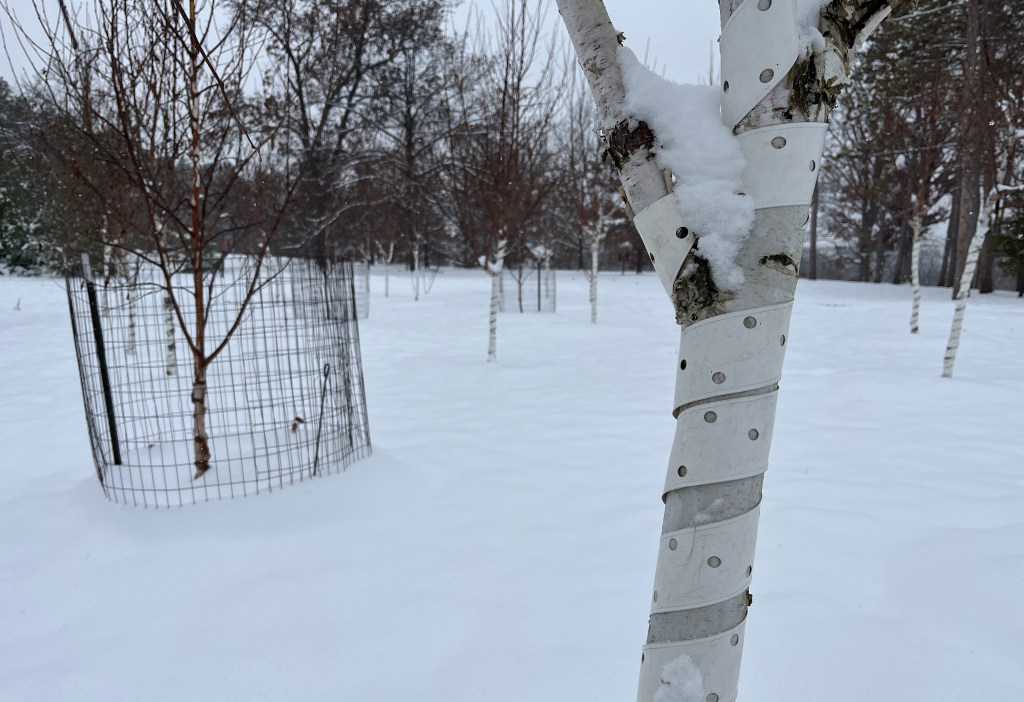
The best protection is to surround young trees and vulnerable shrubs with a cylinder of sturdy wire fencing that is 4 feet high and wide, tall and large enough to keep animals from reaching through the mesh to eat the branch tips. Rabbits standing on their hind legs can reach at least 2 feet up a plant, and deep snow can boost them higher. Deer can stand and reach as high as 8 feet into a tree, but not if they can’t get close enough.
Focus on younger, smaller plants. Older trees armor themselves with thick, tough bark and well-established shrubs can usually afford to lose a few twigs or buds to animals. “Put your effort into protecting things you planted within the last few years, or shrubs that were heavily damaged by animals in previous winters,” Yiesla said.
Spread mulch carefully. “If it’s too deep, it can provide cover to small animals,” she said. Small animals such as voles (similar to mice) can burrow through mulch to chew feed on the bark of young trees. Don’t skip mulch, because it’s highly beneficial to plants, but spread it no more than 4 inches deep. Create a no-go zone for voles and other small bark chewers by making sure the mulch layer stops at least 3 inches clear of a tree’s trunk or a shrub’s outer stems. Voles are prey animals, terrified of attacks by sharp-eyed predators such as owls, hawks and foxes, so they avoid venturing into the open where they could be seen.
Protect against deer rub. Male deer often rub their antlers on trees’ bark when the fuzzy velvet that covers them starts to itch. The rubbing also serves to mark territory. In late winter, when it’s time for a male deer to shed his antlers and start growing a new set, he may also use a tree to knock the old ones off.
“It won’t hurt a mature tree with thick bark, but on a young tree, deer can rub that thin bark right off,” Yiesla said. Bark is a vital organ to a tree and is much harder to repair or replace than twigs and branches.
Most deer rub damage is done at a height of between 18 inches and 5 feet, and the best prevention is that wide cylinder of sturdy wire mesh.
Plastic tree guards are also available that spiral around a tree’s trunk and will deter deer to some extent. Choose one with plenty of openings for air circulation, and remove it promptly in early spring. Tape wrapped around the trunk will not be effective.
Don’t rely on repellents. Although some repellent products may help discourage animals — especially products containing capsaicin, the compound that gives hot peppers their heat — they vary widely in effectiveness and are not a reliable solution. They can also be labor-intensive to use because they need to be reapplied often, especially after it rains.
“The most dependable protection is a physical barrier,” Yiesla said.
