



Going into this winter’s Christmas Bird Count, Anchorage organizers expected a subpar tally, given the unusually strong and cold winds roaring through the city on Dec. 14, the local area’s designated count day.
Postponing the count wasn’t an option, given all that goes into planning the annual event. Local birding enthusiasts would simply have to tough out the fierce gales and frigid wind chills while trying to find as many birds as possible.
Not every Anchorage counter braved the stormy weather; some remained indoors while monitoring the bird feeders in their yards. But to get a more complete sense of the local bird populations that reside here in winter, a substantial number of the 141 participants had to leave the warm comfort of their homes while walking, skiing or driving their appointed rounds.
In the words of local celebrity Mr. Whitekeys, the Anchorage Audubon Society’s self-described “commander in chief” (and better known in birding circles simply as Keys), “Conditions were brutal, but the birds were still there, even though they were hunkered down in the calmest spots available.
“In spite of the wind insanity,” he continued, “Our intrepid counters found 41 species … in the normal range for Anchorage Christmas Counts.”
Among those 41 species, participants counted 13,225 individual birds. Another of Anchorage’s top birders, and one of the local CBC’s five area leaders, Thede Tobish, emphasized how remarkable both results were: “I’m amazed how well we actually did this year (despite) the terrible weather conditions. Both the total count number and the total individuals counted were surprisingly above or near the (long-term) averages.”
Anchorage’s count is part of a much larger, international CBC effort that goes back to 1900, when ornithologist Frank Chapman proposed a Christmas event that would count birds instead of shoot them, which had long been an American holiday tradition.
That first year, Chapman and 26 other conservation-oriented birders counted some 90 species, spread across North America from Toronto, Ontario to Pacific Grove, California.
Jump ahead 124 years to the winter of 2024-25, the most recent year for which complete numbers are available, and the National Audubon Society reports the Christmas Bird Count included more than 80,000 participants, who searched for birds in 2,693 “count circles” (each one 15 miles in diameter), spread across 21 countries or territories. Those counters documented more than 44 million birds and 2,503 species.
Despite an all-time record for participants, both the number of species and individual birds observed fell from the previous winter, continuing a decline first noticed in 2014, an alarming circumstance that demonstrates the importance of such “citizen science” efforts, both to document long-term trends and show the need for increased conservation efforts.
Anchorage’s own CBC can be traced back to 1941, when high school senior Clayton Pollard learned about the national census and decided to do his own accounting of local birds. Between 10 a.m. and 4 p.m. on Dec. 27, Pollard observed three magpies, six ravens, 10 long-tailed and six Hudsonian chickadees (now known as black-capped and boreal chickadees, respectively), seven pine grosbeaks and 59 common redpolls, for a total of six species and 91 individuals. Pollard would eventually become recognized as one of the world’s great birders, with a life list of 7,350 species.
Nearly two decades would pass before the next Anchorage CBC was organized, on Jan. 2, 1961. Central to that effort was Pete Isleib, widely recognized then and now as an extraordinary birder, maybe the best ever to reside in Alaska. Except for a couple of gaps in the early 1960s, the Anchorage count has occurred every year since and for many years has been organized by the Anchorage Audubon Society.
Here are a few more Anchorage CBC facts and figures:
• 52: The highest number of species recorded in a single count, back in 1984 (in recent decades species numbers have normally ranged from the high 30s to the mid-40s).
• 30,606: The largest number of individual birds counted during a single day, in 2008. More than 22,000 of those were bohemian waxwings, which roamed Anchorage in unusually large numbers that year.
• 179: The largest number of Anchorage CBC participants, in 2016. That placed Anchorage among the top 10 counting areas anywhere in the U.S.
• 103: The total number of species seen across the years in local Christmas counts.
• 5: The number of areas (or sub-areas) within the larger whole. Each has a count leader, responsible for organizing the count effort and compiling the data within his or her section of Anchorage.
This year’s Anchorage Christmas Bird Count resulted in several noteworthy facts and figures.
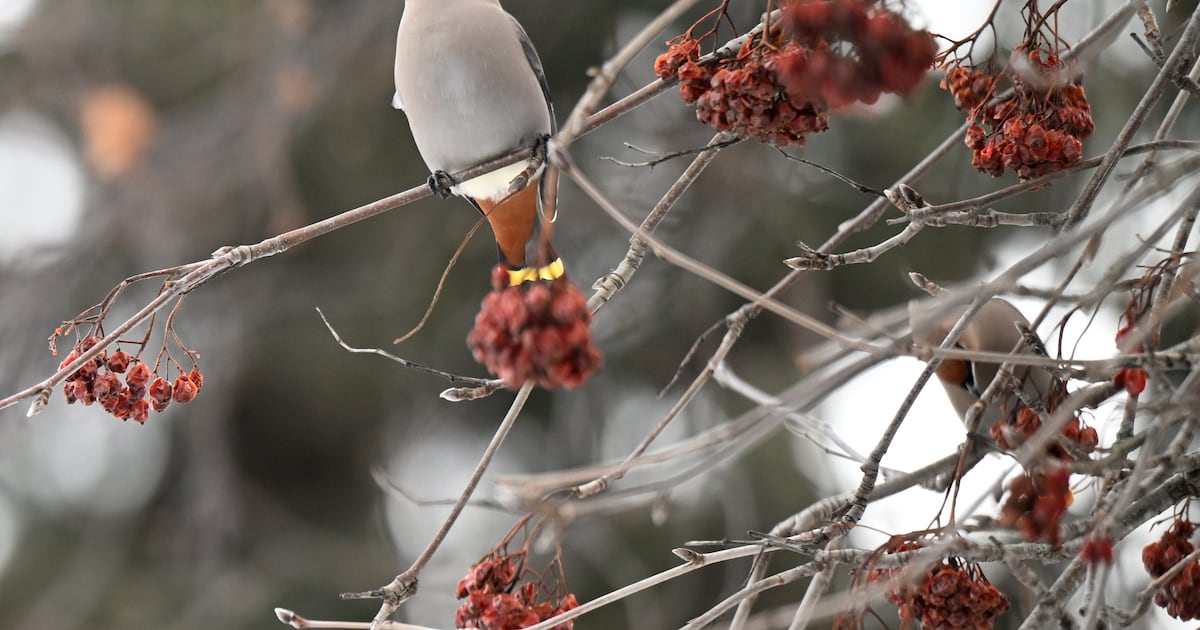
As is usually the case, bohemian waxwings were the most abundant species counted, with 2,435 individual birds spotted. (Wide-ranging birds like waxwings, ravens, and bald eagles are typically counted only until noon, to minimize the possibility of duplication.) Despite that large number, Keys points out that 2,500 is a “very low count” for waxwings, which some years number several thousand birds. As noted above, in 2008 more than 22,000 waxwings were counted, a truly amazing number.
Right behind waxwings were mallards, at 2,065 birds, the highest in 18 years. Next, common redpolls, a wide-ranging “irruptive” species of finch; their total of 2,057 birds was “somewhat near normal,” according to Keys.
Also abundant were two non-native “invasive” species, rock pigeons (1,428 birds, the third-highest number ever) and European starlings (1,393, fourth-highest ever). Despite their substantial presence, “We can breathe a sigh of relief,” says Keys, because their numbers dropped from last winter’s all-time highs, “so things are slightly looking up, even though the improvement is tiny.”
This year’s local CBC also produced two records. For the first time ever, a ruffed grouse was spotted on count day. Though a native species north of the Alaska Range, it was introduced to the Mat-Su area “and has been spreading slowly into Anchorage,” Keys explained, with this bird’s discovery clear evidence of that spread.
The other record: 90 bald eagles, the most ever seen on Anchorage’s count day.
“Other aberrant birds,” Keys noted, were a single golden eagle, seen only once before on count day; two Pacific wrens and one Harlan’s hawk, each species observed on only three past CBCs; and a rusty blackbird, seen four times previously.
Among the notable no-shows: None of the three species of ptarmigan to inhabit the mountains east of Anchorage were seen. This wasn’t especially surprising, given the ferocious winds ripping through the Chugach Front Range (part of which is within the Anchorage count area), though a couple of resolute counters hiked high into the hills, one nearly to the top of Near Point.
In considering this year’s overall count, area leader Pat Pourchot said that while year-to-year variations and long-term trends are “interesting to note, the ‘why’ is often ambiguous or unknown.” Food availability is certainly a factor, Pourchot noted, “but some variables are harder to assess, like particular weather on or around count day,” this year’s high winds being an excellent example. “Even more speculative,” he adds, “is the (long-term) effect of climate change.”
In short, many unknowns likely affect the annual counts. But long-term CBC records are invaluable at both the local and international level. For that, both organizers and participants deserve our thanks, whatever the count day conditions.
Anchorage Audubon Society
2025 Christmas Bird Count list of species
Bohemian waxwing: 2,535 (very low count)
Mallard: 2,065 (highest in 18 years, but lower than years before that)
Common redpoll: 2,057 (irruptive, somewhat near normal)
Rock pigeon: 1,438 (third highest ever)
European starling: 1,393 (fourth highest ever)
Black-capped chickadee: 1,055 (low end of normal)
Common raven: 794 (pretty normal)
Black-billed magpie: 568 (low end of normal)
Red-breasted nuthatch: 266 (somewhat normal)
American robin: 202 (highest in eight years)
Boreal chickadee: 157 (low normal)
Pine grosbeak: 136 (low)
White-winged crossbill: 133 (overall normal; way off irruptive years)
Bald eagle: 90 (highest ever)
Steller’s jay: 56
Dark-eyed junco: 49 (normal)
American dipper: 43 (high)
Downy woodpecker: 42 (low normal)
Golden-crowned kinglet: 23 (normal)
Hairy woodpecker: 20 (normal)
Common merganser: 17 (higher than normal)
White-crowned sparrow: 15 (fairly high)
Brown creeper: 9
Common goldeneye: 6 (big numbers until 2005, low since then)
Canada jay: 8
Ruby-crowned kinglet: 5
Pine siskin: 5 (low)
Northern shrike: 3
Pacific wren: 2 (fourth recorded)
Northern goshawk: 2
Spruce grouse: 2 (normal)
Great horned owl: 2
Belted kingfisher: 2 (one or two is normal)
Golden-crowned sparrow: 1
Rusty blackbird: 1 (fifth recorded in 27 years)
Golden eagle: 1 (second recorded)
Northern pintail: 1
Red-tailed Harlan’s hawk: 1 (fourth recorded)
Ruffed grouse: 1
Wilson’s snipe: 1 (fairly usual)
Northern flicker: 1 (normal)
