


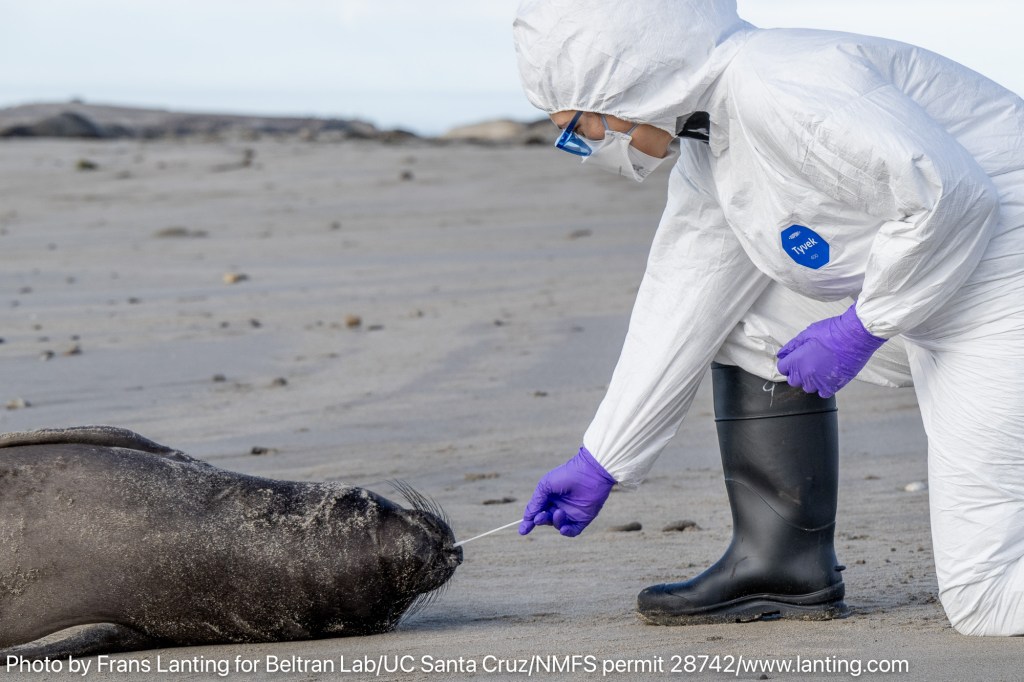

SANTA CRUZ — The Marine Mammal Center received multiple reports of a northern elephant seal pup on two different Santa Cruz beaches earlier this month. The sightings were the first reports of the animals in Santa Cruz since an outbreak of highly pathogenic avian influenza, also known as bird flu, began in a colony of elephant seals at Año Nuevo State Beach.
The Marine Mammal Center received multiple reports that an elephant seal pup had come onto the shore at a beach near West Cliff Drive March 12, confirmed Giancarlo Rulli, the organization’s associate director of public relations. Later, the center received additional reports of an elephant seal pup going in and out of the water on Its Beach, another beach along West Cliff Drive. Rulli noted that it may have been the same animal spotted on both beaches, but that without sufficient evidence, the Marine Mammal Center can’t be sure.
Experts are still working to get more information about the bird flu outbreak. So far, 27 northern elephant seals, one southern sea otter and two California sea lions have tested positive for the virus. The outbreaks have been concentrated at Año Nuevo and the beaches directly north and south of the park, in San Mateo County near the border of Santa Cruz County. Santa Cruz County is considered to be within the wider hot zone for the outbreak, considering its proximity to Año Nuevo, Rulli said.
Usually, the Marine Mammal Center would respond to reports of a living marine mammal washed up on the beach. But due to the bird flu outbreak, the organization is not currently responding to Pacific harbor seals or northern elephant seals. While the risk to the general public is low, volunteers responding to marine mammal sightings would have a high risk of exposure due to their close proximity to the animals. The Marine Mammal Center is working to update its safety protocols and prepare personal protective equipment for its 1,400 active volunteers.
As more information becomes available, the center could change its protocols around elephant and harbor seal responses, Rulli said. If the Marine Mammal Center resumes its responses to elephant and harbor seals, all the animals it rescues will be swabbed and tested for diseases including bird flu, which has always been a part of their response protocol.
In Santa Cruz and Monterey counties, Rulli said, around 25% to 30% of the marine mammals the center responds to have contact with humans or dogs. Because bird flu could possibly spread between species, the public is advised to keep themselves and their pets a safe distance of 150 yards from marine mammals and birds, which can also carry the virus. Even though the center is not currently responding to harbor and elephant seals, sightings should still be reported so the organization can keep track of where the animals are and monitor them long term.
Paige Laurenzano, who was visiting Santa Cruz from San Francisco March 12, is one of the people who reported the elephant seal pup to the Marine Mammal Center. She said she also reported the animal to other agencies, including the Marine Mammal Stranding Network, which responds to dead animals. Laurenzano said she tried to get in touch with State Parks officials from Lighthouse Field State Beach and officials from the city to close off part of the beach while the elephant seal was on the sand but had no luck.
Laurenzano said she saw beachgoers and their dogs get close to the elephant seal pup. She said she knew about the bird flu outbreak, so people’s behavior around the animal concerned her. She found it disappointing that none of the agencies who could have responded to the sightings were able to do anything about the animal.
Experts are continuing to watch the outbreak closely. Scientists are surveying the beaches in and around Año Nuevo State Park, observing the elephant seal colony using drones, and continuing to swab and test animals for the virus in hopes of learning more about the virus and its transmission pathways.
As scientists continue to survey Año Nuevo beaches, they find an average of two newly sick elephant seals and two newly dead elephant seals each day, said Patrick Robinson, Año Nuevo Reserve director at UC Santa Cruz. About four times the usual number of pups have died during this breeding season, and there have been more deaths among male adults. As of March 12, Robinson estimated that around 47 elephant seals had died on the mainland of Año Nuevo State Beach during the breeding season, although it’s likely that some of those deaths were due to other causes. There is evidence that the sick animals have brain infections and pneumonia, said Christine Johnson, director of the Institute for Pandemic Insights at UC Davis. While the mortality rate for elephant seals is unknown, it seems as though many sick animals eventually succumb to the virus.
Despite the toll the virus has taken on elephant seals, as well as at least two sea lions and one sea otter, experts are cautiously optimistic. The virus hasn’t spread much, and scientists have observed some previously symptomatic pups alive without symptoms, suggesting that the animals can sometimes recover from the virus. In addition, most of the female adult elephant seals had already left Año Nuevo when the outbreak began. The females that UC Santa Cruz researchers track out in the ocean seem to be behaving normally, Robinson said.
“There are still thousands of apparently healthy elephant seals,” Robinson said.
While the outbreak is certainly of concern, said Christine Johnson, director of the Institute for Pandemic Insights at UC Davis, it hasn’t spread much yet. The infection of sea lions and sea otters is cause for close monitoring of those populations, but according to Johnson, such one-off infections in other species are typical for an outbreak like this one.
“It’s been a very limited outbreak, thank goodness,” Johnson said.
Members of the public are encouraged to call the Marine Mammal Center’s hotline at 415-289-7325 if they see live marine mammals, and the Marine Mammal Stranding Network’s hotline at 831-212-1272 if they see dead marine mammals.
