


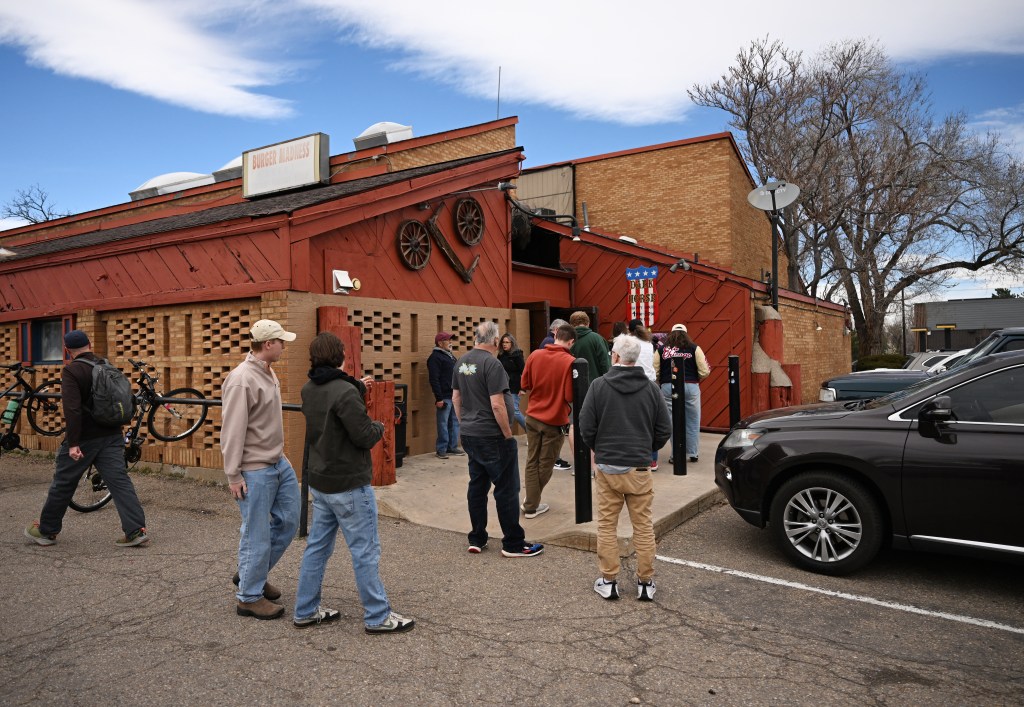

BOULDER — Inside, past the sign touting the “Starving Student” meal deal of a burger, fries and a beer for $9.49, across from the bathrooms with hands directing men and women to enter the opposite door, a few steps from the old Rockola jukebox, Brady Brown was fuming.
The demise of the Dark Horse, Boulder’s world-famous bar and burger joint just off U.S. 36 on Baseline Road, had him riled up as he hung near the entryway with a friend on a Wednesday night last month. The line to get in earlier had snaked around the parking lot, and it was nearly standing-room only inside before half the crowd headed to campus for the men’s basketball game.
“This place is part of Boulder’s soul,” said Brown, who first discovered the World Famous Dark Horse in 1992 after enrolling at the University of Colorado to pursue his doctorate in Aerospace Engineering. “It’s what makes Boulder unique. There’s no place else like this place. How do you (expletive) tear this place down? I just don’t get it.”
For nearly two years now, patrons of all ages — Boulderites, barflies, and CU students and alums — have shown up here asking the same question ahead of Saturday’s closing. They’ve come to scratch a nostalgia itch and say their goodbyes to an old friend, a dark, dusty institution that has remained largely unchanged over five decades as the college town around it has undergone repeated facelifts.
Cheap beer. Killer burgers, wings and onion rings. And so much weird crap hanging from the walls and ceilings, it’s a wonder how it all got crammed in here in the first place.
It’s been a helluva run, for sure.
A unicorn. A time capsule of Boulder from a different era. Everyone who grew up here, or went to college here, has Dark Horse memories, some more debauched than others. Rowdy Friday Afternoon Clubs. Drunken tricycle races. Male strippers on ladies’ nights. Costume parties. Trivia nights, karaoke nights and live music. Dancing on Friday and Saturday nights. And the last call crowd singing the “Hallelujah Chorus” at closing.
Ever since developers of Williams Village II presented their plans to the city in early 2024, over the objections of many community members, the slow march to the Dark Horse’s closure has been a living wake for longtime patrons.
Jeremy Martin is one of those Dark Horse lifers. On this Wednesday, he was celebrating his 71st birthday with friends in the pit of the main bar room that served as a dance floor back in the day.
“I’ve been coming here since I was 21, when they opened up,” said Martin, a third-generation local who graduated from Boulder High and CU’s Leeds School of Business. “I’ll always remember having good times with friends and partying and not remembering what we did and playing foosball and pool. And some people getting thrown out.”
Many had held out hope that maybe, just maybe, the weirdest place in a town that relishes its eccentricity would be saved from the bulldozer in the new development that will deliver 427 new housing units and nearly 60,000 square feet of commercial space.
Locals packed the initial Boulder Planning Board hearing in January 2024 to voice strong opposition to the plan that would raze the building. There’s been an outcry ever since. Comments on social media posts have run into the hundreds.
But, after a few reprieves from the developers of Williams Village II, the Dark Horse’s ownership announced in early February that it will officially close on Saturday night, its 51st anniversary.
“While this is not the path we would have chosen for this historic location or our business, we are deeply grateful to have been part of Boulder’s culture for more than half a century,” read an announcement posted to the Dark Horse’s Facebook page. “As sad as we are, we plan to honor the Dark Horse by closing with as much joy, energy and fun as possible. We invite you to utilize this final month, especially March 14th, to come make some final memories, enjoy the history, and honor the legacy that we have built together as a business and a community.”
Two years ago, after that initial presentation to the Boulder Planning Board, the property owner, Petur Williams, and business owner, Dave Tobin, wrote in a guest opinion that they planned to save the Dark Horse. Working together, they wrote that the next iteration of the restaurant would emerge in the new development.
“The building is over 50 years old, leaches energy, lacks many features required in today’s restaurants and could never meet today’s code,” they wrote. “It’s not worthy of landmarking or preservation status.”
Repeated attempts to contact Tobin about the future of the business after Saturday’s closing were unsuccessful.
While it may not be worthy of historic designation, Brown, Martin and many others would disagree that the old Dark Horse isn’t worthy of saving.
“Trey (Parker) and Matt (Stone) stepped in and saved Casa Bonita because they understood that that was such a touchstone for Denver,” Brown said. “This is a touchstone for Boulder. How do you tear this place down? Build a bubble over it in the new development. This is the destination.”
Boulder’s ‘pleasure palace’
Indeed, the Dark Horse has been a bucket-list stop in Boulder since it opened its doors nearly 51 years ago.
It boasted three bars on two floors, a beer wagon, a giant TV that screened live sports, “Star Trek” reruns and classic movies like “The Wizard of Oz,” as well as pinball, ping-pong, foosball, chess, darts, free popcorn from a pot-bellied stove and a dance floor.
More importantly, for cash-strapped college students, it offered some of the cheapest booze and grub in town — 69-cent drinks, 39-cent beers and a half-pound burger for $1.59. The Daily Camera reported in early 1977 that as many as 4,000 to 5,000 people passed through the bar on Friday nights during its popular happy hour from 4 to 7 p.m.
Launched by Grand American Fare Inc., a Santa Monica-based company started by a group of Western Airlines pilots, the Dark Horse was among a chain of restaurants stuffed with odd memorabilia culled from both ends of the country.
The company’s principal owner owned warehouses full of junk in Maine and Santa Monica. More than $500,000 of decor — worth more than $3 million today — was housed in the chain’s 11 restaurants in California, Arizona and Colorado when the Dark Horse opened, according to the Daily Camera archives.
More restaurants followed in Colorado college towns — Washington’s in Old Town Fort Collins and the State Armory in Greeley.
Hanging above the old dance floor are some 40 carriages and sleighs, including a picture-windowed hearse from the 1940s, turn-of-the-century, hand-carved merry-go-round horses. Magazine collages on the walls of the upstairs section include faded Playboy centerfolds, retro posters, cartoon characters and other ephemera. There’s also assorted animal heads, an old cash register, old books that haven’t been cracked open in half a century, and assorted portraits.
The former manager of the bar boasted that Grand American Fare Inc. had the largest collection of Playboys in America. There are also license plates from all over the country, as well as cryptic messages carved into the tables and benches from patrons of eras past.
Pat Ranney, a St. Louis transplant who graduated from CU in 1976, said she used to religiously come to the Dark Horse on Friday afternoons at 4 to catch reruns of the original “Star Trek.”
“It hasn’t changed,” she said. “A ittle dustier.”
On a weekday afternoon earlier this month, she was enjoying a burger and a glass of wine with her older sister, Alice Ranney, also a CU grad.
“We just started coming back when we heard they were going to close,” Pat Ranney said. “We went to the holiday concert at CU and then we came over here. Then we went to a women’s basketball game a couple weeks ago. And we came here. And we thought, well, one more time.”
Alice Ranney said there are so few places left in Boulder that connect generations of residents and alums. The only other college hangout with as much local history is The Sink on University Hill, which opened in 1923.
“My concern is, where are all these old people going to go now?” Alice Ranney said. “Like us. It’s multi-generational. It’s just a real hometown place. This has character. So many places in Boulder don’t have character anymore.”
Finding love at the ‘Shady Pony’
John Reilly, 74, said he shared his first kiss with his wife, Lisa, in the hallway of the Dark Horse back in 1977.
They’d danced earlier that night at another popular singles spot, Anthony’s Garden at the former Hilton Harvest House Hotel, and later wound up at the Dark Horse, where they were both regulars. He loved the foosball. She loved the dancing.
“I didn’t even know they had food,” Reilly said with a laugh. “I just went there for the beer. And to chase girls.”
The couple has been married for 45 years. They took their last trip to the Dark Horse on Valentine’s Day last month.
“I’m really sad to see it go, but when we went there for Valentine’s Day, you could tell they’ve neglected the maintenance for quite a while,” said Reilly, who said his Boulder High senior class would gather every year at the Dark Horse on the second Friday in December. “It was my go-to place for a long time. Two or three times a week.”
Scroll through the hundreds of comments underneath posts about the Dark Horse’s closing, and there are too many stories like Reilly’s. Women who met their husbands there. A man who wrote that he entered the wrong bathroom — a Dark Horse rite of passage — and bumped into his future wife. A woman who wrote her husband proposed to her by the fireplace. Another wrote she dated a bouncer, and another wrote that she dated one of the male dancers from the popular ladies nights who went by “Ponyboy.”
Back in its heyday, the Dark Horse was the place to go to meet other young people in Boulder. And it attracted a diverse crowd — bikers, hippies and disco fans, all under one roof — for some wild times.
Tricycle races. A live goldfish-eating contest. A Debby Harry lookalike contest.
“My buddy, BJ, they have a saddle mounted on the ceiling upside down,” Reilly said. “He could get up on that thing and ride it. Hanging upside down. He only weighed like 100 pounds.”
‘An unknown sports bar’
Eskimo Joe’s in Stillwater, Oklahoma. Harpo’s or Bullwinkle’s in Columbia, Missouri. P.O. Pear’s in Lincoln, Nebraska. The World Famous Dark Horse in Boulder.
Back in the Big 8 era, traveling sportswriters knew the circuit, said Dave Plati, CU’s legendary sports information director who now serves in an emeritus role with the athletic department.
“Kind of, in a way, you can pass it off as an unknown sports bar,” Plati said. “Because it had plenty of TVs where you could watch sports, but they never presented themselves as a sports bar. Being a sports guy in Boulder, the choices were so limited, that’s where we always went.”
Plati said he always recommended the Dark Horse to visiting scribes when they came to town.
“If they did’t want to go out for a fancy steak or something, we’d tell them, go to the Dark Horse,” he said. “You can watch whatever games are on tonight, get a great burger. It’s a fun environment.”
A fun environment for everyone, really — not just students or alums or regular joes.
“It was one of the few places in Boulder that wasn’t limited to either one or the other,” Plati said. “A lot of those other places, it seemed to me, you were either going where the students went, or after your student days, you were going where the students weren’t.”
‘This is one of the last anchors’
Washington’s in Fort Collins shuttered in August 2016 with a blowout two-day party after 38 years in business. More than 5,000 pieces of memorabilia were auctioned off, including a mini submarine and an old howitzer. The building in Old Town, the last and largest restaurant that Grand American Fare opened, has since been repurposed into a live music venue.
The State Armory in Greeley, housed in a historic 1920s National Guard Center, closed on New Year’s Eve in 2006. The real estate investors who bought it eventually auctioned off the contents of the building in 2009 — everything from the urinals to the Jack Daniel’s whiskey barrels.
A popular hangout of the Broncos during training camps in Greeley, the building has since been added to the Greeley Historic Registry and reopened in the spring of 2025 as a community collective with a coffee shop, bookstore, plant store and a stage for community events.
As to the fate of the carriages and sleighs, the Big Boy Burger mascot, the bathroom doors and all the other old memorabilia in Boulder’s World Famous Dark Horse? Dave Tobin, who got a job working the door when the bar opened, and eventually worked his way up to waiter, bartender and regional manager, before purchasing the restaurant in 1993 after Grand American Fare went under, hasn’t said.
A staffer at the Dark Horse, who asked not to be named, said she had heard that some items would be auctioned off and others would be repurposed for the new restaurant that plans to open in the new development.
Since the announcement of its closure, business couldn’t be better. Local history groups have been coming for informal happy hours, and alums and students have been savoring their last bites and sips, especially on game days for the CU men’s and women’s basketball teams.
Saturday promises to be a blowout to rival all the other legendary Dark Horse parties of years past.
“It’s like everything in Boulder, it’s changed so much,” Martin lamented. “And this is one of the last anchors here of that kind of place. It’s sad, but change happens.”
“There’s no place else like this place,” Brown said. “It just tears my heart out that they’re tearing this thing down.”
