


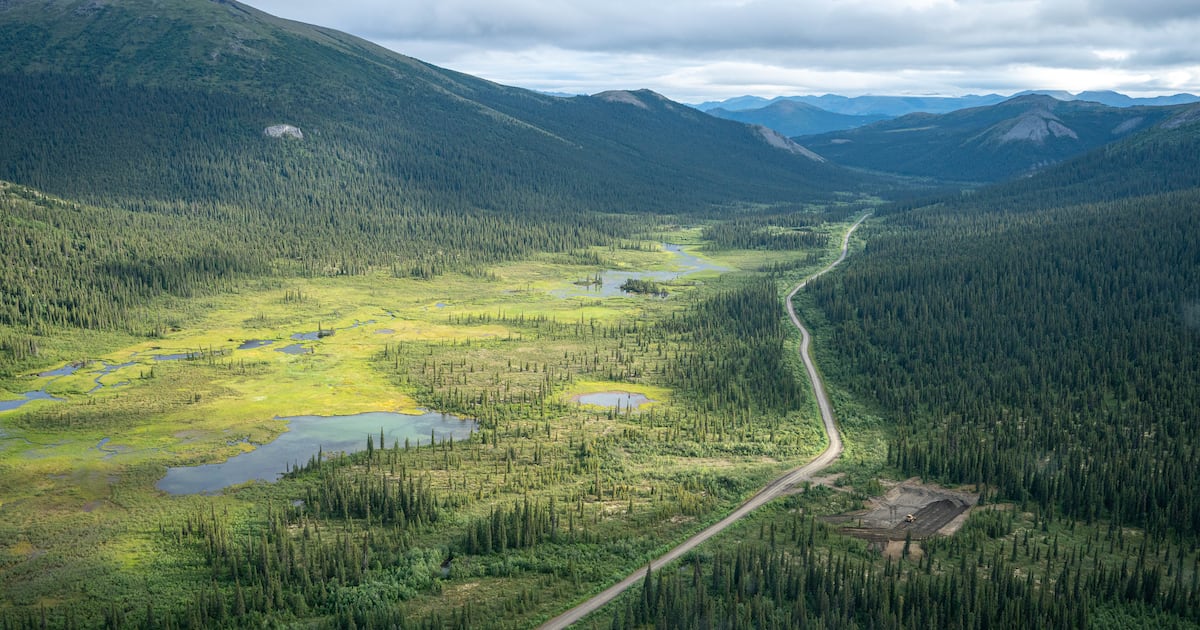

The state’s proposed 211-mile Ambler Road to a mineral district in Northwest Alaska will cost more than $2 billion, according to a new report commissioned by a conversation group.
Even that could be an underestimate, based on much costlier construction estimates for other remote and lengthy Alaska road proposals, the West Susitna Access road and the Western Alaska Access road to Nome, according to the report by LNE Engineering and Policy.
The head of the state agency developing the project pushed back on the report’s conclusions Monday, saying it was premature to arrive at its cost estimate.
LNE Engineering, owned by Alaska-licensed engineer Lois Epstein, is a consulting firm that provides services to conservation groups and Alaska Native tribes.
The Alaska Wilderness League commissioned the study, she said. It was also supported by the Defend the Brooks Range coalition that opposes the road.
Project developer Alaska Industrial Development and Export Authority has proposed issuing bonds to pay for the road. The state agency has said it would repay the bonds by assessing fees on the mining companies that would use the road.
Plans call for a two-lane gravel road extending west through wilderness from the Dalton Highway. It’s designed to open a mining district containing copper, zinc, lead and other minerals considered critical by the federal government for their economic and defense value.
The report takes issue with the project’s financing plan, saying that potential “mine developers have not committed to fully reimburse AIDEA and are likely to negotiate tolls that are as low as possible.”
The report takes estimates provided by the Bureau of Land Management and adjusts those for inflation.
Today, construction alone would cost $765 million, the report says. Other costs, such as financing, and maintenance over 50 years, would add about another $1.3 billion.
That may not be all, the report says.
The report also asserts that additional factors could push costs higher, such as acquiring access to Doyon and NANA lands and the high cost of wages in Alaska compared to other states.
“This report tells us that AIDEA has significantly underestimated the cost of this private road to a speculative mining district,” Epstein said in a statement from the coalition.
The report says the current $765 million in construction costs might also be significantly higher if its compared to other road projects proposed by the state, it says.
Construction costs alone for the Ambler Road would be $1.2 billion, if was based on the same cost-per-mile estimate previously used for the 548-mile Western Alaska Access road, the report says.
The construction costs would be $2.2 billion, if it was based on the same cost-per-mile estimate previously used for the West Susitna Access road, between 34 miles and 108 miles depending on the route, the report says.
The gap in per-mile cost estimates between the three different projects, which would all cross mountainous topography and permafrost and numerous fish-bearing waterways, suggest there “are meaningful deficiencies” in the estimated cost of the Ambler Road, the report says.
The report recommends a “detailed, comprehensive analysis of the accuracy of the proposed road’s total cost estimate before proceeding with construction,” one that’s consistent with the West Susitna and Western Access analyses.
Also, decision-makers should review new, detailed cost estimates and “reassess whether the state should pursue the project,” the report says.
Randy Ruaro, head of AIDEA, said Monday that he hadn’t read the report but said there are too many unknowns to estimate a final, full cost for the road project.
The agency is also exploring many potential opportunities that could lead to reduced costs, including the use of relatively inexpensive pre-fabricated bridges, savings depending on the source of the gravel, and financing that may not involve bonds but rather an inexpensive loan from the Department of Energy.
“They should wait until we get all the information and actually produce a very solid estimate before they start throwing numbers around,” he said. “Until you get the technical information and the design of the bridges — the bridges are going to be a significant cost — and until you have those pretty nailed down, you don’t really have a very solid estimate.”
Multiple mining operations could also get underway that could help spread costs associated with the road, he said.
“Ultimately, we think it’s going to be a successful project that’s going to bring a lot of jobs and opportunity and benefit the whole region, both the Doyon and the NANA side,” he said, referring to regional Alaska Native corporations that own land along the route.
