


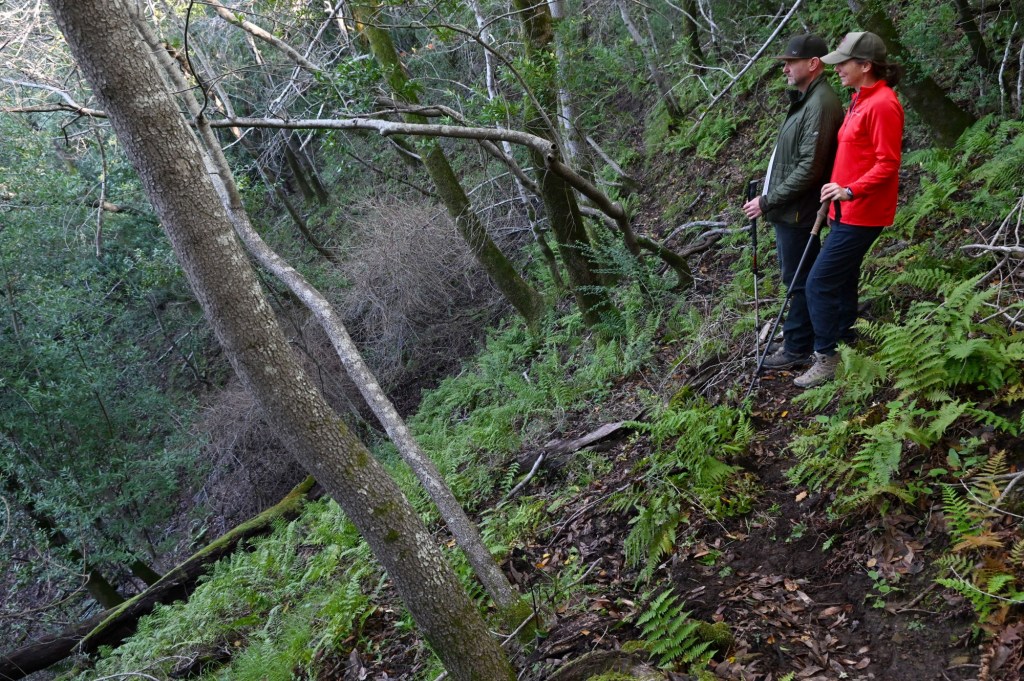

Kristen Wilson followed the deer trail past moss-covered trees and spongy underbrush on the steep verdant hillside above Piper Lane in Fairfax.
“We have a really big madrone up here,” said Wilson, a forest scientist, approaching the ridge. “That’s where the great horned owls have nested in the past and where red tails nest.”
“Up here is where it really opens up and where it’s buildable,” said Paul Wilson, her husband and an electrician, who led the way as the canopy turned to grassland and valley views. “The issue is how would get a road over here, right?”
The outdoorsy couple, who live below at the end of Piper Lane, were hiking through a 1-acre parcel they and 11 neighbors bought in early December and donated to the Western Alliance for Nature, a Marin nonprofit that holds and conserves wildlife habitat.
The parcel, renamed the Piper Lane Preserve, had been designated by Fairfax as a site for single-family homes. Kristen Wilson said the plan included three houses, three accessory dwelling units and three junior accessory dwelling units.
“We thought we missed the boat because the person who bought the land said they were going to develop it,” said Gehry Oatey, who lives next door. “So we just got people together and said, hey, let’s see if we can try to buy it from them.”
The lot borders the 100-acre wildlife preserve known as the Wall property that lies above downtown’s western flank. It was identified as a possible housing site in the town’s housing element, the state-mandated plan to add 490 dwellings by 2031.
Last May, Oatey and Kristen Wilson learned the lot was listed for sale for $110,000. They asked the Fairfax Open Space Committee to consider buying the property, noting it was rich with wildlife and could allow access to the Wall property. Their request was assigned to an acquisitions subcommittee.
“I was really interested in preserving it because I have recorded spotted owls on the property,” Paul Wilson said. “It’s also quite a beautiful piece of property, with deer that frequently migrate up and down the hill and bobcats and coyotes — just to name a few of the wildlife there.”
The Open Space Committee replied it didn’t have the funds and suggested the neighbors buy it. The parcel soon sold for half the list price to Kevin Curtis.
That led the committee to contact several land conservation experts, including the Marin Open Space Trust and Rene Voss, an environmental law attorney and executive director of the Western Alliance for Nature.
“We fit a niche here in Marin County as an organization that is willing to actually hold what we call upland properties,” Voss said. “We have three other preserves.”
Voss was concerned the site — along with eight other parcels on the town’s perimeter — were “known” wildlife habitats but listed in the housing element.
But he wanted to help. Voss contacted Wilson and they reached out to the buyer, who was open to selling if he could recover his costs.
“As the person who had the property under contract, I was struck by how respectfully and collaboratively the neighbors approached me,” Curtis said. “I’ve rarely seen that level of organization and goodwill, and it made a real difference.”
Wilson put letters in neighbors’ mailboxes inviting them to a meeting in her living room. Wilson and Voss pitched the plan.
If everyone chipped in, the Western Alliance for Nature would take the property. The deed would have development restrictions. The contributions were tax-deductible.
“When you can explain something to me that fits on a credit card, that’s brilliant,” said Barbara Bonander, a College of Marin teacher who lives a few doors down. “Kristen and Paul aren’t professional organizers. They’re let’s move on. Let’s get it done. Let’s do it fast.”
“We had one meeting in November with Rene and the neighbors,” Kristen Wilson said. “And within one hour, we had raised almost all the funds we needed.”
“People were hungry to do something good,” Bonander said. “It wasn’t, let’s go after this developer. It was, we’re going to do something that’s very positive.”
The Western Alliance for Nature acquired the parcel on Dec. 12.
“Once Western Alliance for Nature became involved, it was clear there was a sincere effort to preserve the land rather than oppose development for its own sake,” Curtis said. “My condition in moving forward was that a permanent deed restriction be recorded to ensure long-term conservation, and that standard has now been met.”
Voss, the neighbors and Curtis hope the town will eventually take over the preserve.
“Rene Voss has made clear that WAN’s policy is to allow public access on conserved properties, which I fully support,” Curtis said. “While the town initially said it could not accept the parcel, the property is now protected, paid for, and well positioned to be integrated into the larger open space system alongside the Wall property.”
Fairfax officials praised the effort and actions of all involved, but some said taking over the parcel is not in their plans.
“We sincerely appreciate WAN’s recording of the deed restriction,” said Mayor Stephanie Hellman, “and request that they not only passively own it but also steward it into the future.”
“We are grateful to the neighbors … and to WAN,” said Councilmember Barbara Coler. “While it sounds simple to acquire property, it comes with many responsibilities.”
They include removing fire-hazard vegetation and trash, and ensuring there is no camping, Coler said.
“It is unlikely that the town would take the property in the future given these responsibilities and the potential for landslides on the property and thus the potential liability for the town,” Coler said.
Coler, who was mayor in 2024, also oversaw the housing element update that was adopted that year. The process involved designating potential housing sites to meet the state quota, and developing an environmental impact report that included listing endangered and threatened species, including northern spotted owls.
Coler said the housing element also required Fairfax to identify housing sites that comprised an additional “buffer of 90-plus units” to the town’s 490-dwelling quota to ensure it met the state mandate if “certain properties fall of out the housing element.”
The town’s consultants identified sites away from the downtown so all new housing would not be clustered there.
“As you can imagine, it was difficult to find locations,” Coler said. “However, I note that more than 60% of the sites were located away from the hills and closer to downtown.”
Councilmember Mike Ghiringhelli, who has criticized the state housing mandate and the town’s compliance, said there is no need for “housing sites located on our previous open space properties.”
“They are simply not listening to the voices of our communities,” he said.
“All of these undeveloped parcels are sitting in Fairfax’s wildland urban interface fire hazard zone,” said Vice Mayor Frank Egger. “Many Fairfaxians are losing their fire insurance because they are located in Fairfax’s high fire hazard zone. … Why does Fairfax want to add that kind of grief to anyone trying to build on those steep, undeveloped and unstable fire-prone parcels?”
On Piper Lane, Bonander stood on her front porch and looked at parcel’s base. Where would cars for nine new dwellings park? she asked.
“I think we all would say its a bit of a stretch,” she said. “We all understand what the state’s trying to do, but I don’t know that it can be legislated.”
“We are just trying to keep Piper Lane a lane,” Bonander said. “We’re off of the last traffic light in Fairfax.”
