


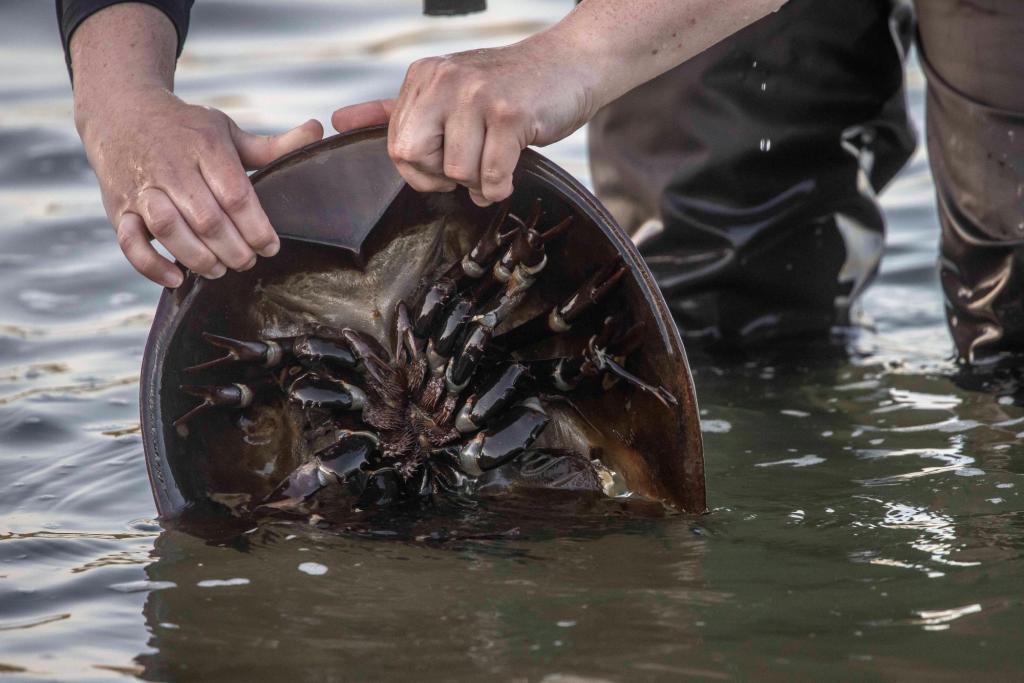

New York state will phase out the catch of horseshoe crabs in its waters for bait and biomedical use over the next four years.
Although supporters of the Horseshoe Crab Protection Act had urged an immediate ban, Gov. Kathy Hochul obtained the agreement of legislative leaders to reduce the catch by increments, leading to a total prohibition in 2029.
She said she had vetoed the bill a year ago because the earlier bill would not have given the fishing industry enough time to adapt.
CT’s ‘living fossils,’ on road to extinction, get fighting chance with new harvesting ban
The allowed catch, to be managed by the state’s Department of Environmental Conservation, will be reduced by 25% in 2026, 50% in 2027 and 75% in 2028 until the full ban goes into effect.
“Horseshoe crabs are a vital keystone species to New York, often called living fossils, and are important to our environment,” the governor said in a statement. “Last year, I vetoed similar legislation due to concerns that this bill could have unintended consequences on the commercial fishing industry and biomedical advancements. The effective date of the bill did not leave those industries enough time to transition to alternatives.”
State Assembly member Deborah Glick, a New York City Democrat who led sponsorship for the bill, called the law “a decent compromise’’ because it gives the fishing industry time to find new sources of bait.
The Long Island Commercial Fishing Association, which had opposed the legislation, did not respond to a request for comment. The fishing industry had argued that a ban would wipe out livelihoods, damage local fisheries and ignore policies that led the industry to reduce the number of crabs it uses for bait.
This animal has lived here millions of years. How a CT-based group wants to save it from extinction.
New York’s harvest ban will help to protect the creatures across a swath of the mid-Atlantic region, following similar prohibitions enacted in Connecticut in 2023 and in New Jersey in 2008.
The New York law also explicitly prevents catching horseshoe crabs for the pharmaceutical industry, portions of which use crab blood to detect toxins in medical products.
But some other states, including Delaware, Maryland and Virginia, still allow horseshoe crabs to be caught for bait, subject to quotas set by the Atlantic States Marine Fisheries Commission, a federal regulator.
Conservationists have long urged state authorities to ban the harvest of horseshoe crabs because they feed other marine species. Dependent species include the red knot, a federally protected shore bird that feeds on the crabs’ eggs. The birds’ population was badly damaged by the overfishing of horseshoe crabs on the beaches of Delaware Bay, a key migratory stopover, starting in the late 1990s.
Larry Niles, a New Jersey-based wildlife biologist who has campaigned for a regionwide ban on the horseshoe crab catch, said New York’s law was another step toward broader protection.
“The governor’s action represents the hard-won fruit of a two-year push to see this legislation signed into law,” Niles said in a statement. “Horseshoe crabs are vitally important to New York estuaries, and rebuilding their population will take time, but the ecological payoff will be priceless.”
In New York, Adrienne Esposito, executive director of the Citizens Campaign for the Environment, said the law would “allow populations to rebound and New York to protect this historic species for future generations.”
Jason Patlis, president of the Maritime Aquarium, a conservation group whose research estimated that the horseshoe crab population in bays and harbors of Long Island Sound has been declining 2% to 9% a year, also welcomed the governor’s approval. “Our research has documented severe declines in horseshoe crab populations, and this decisive step by New York will help reverse that trend,” he said.
