


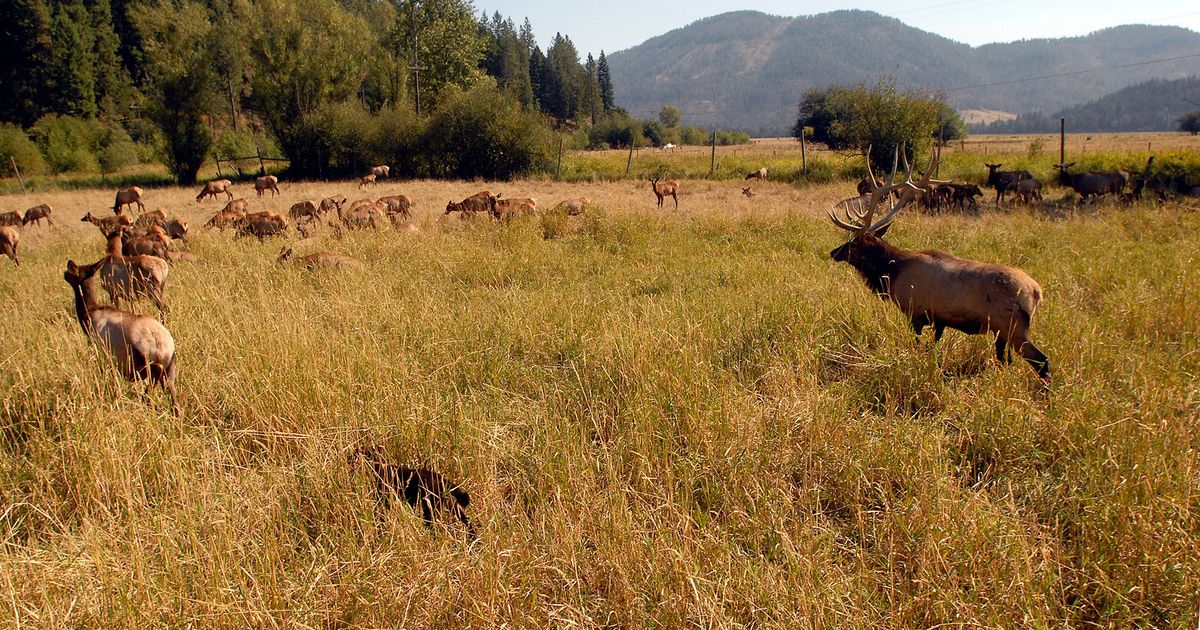

Despite legislative testimony saying it was unlikely to happen, some of Idaho’s domestic elk farms have proven to be porous with multiple examples of wild animals getting into the high-fenced operations and domestic animals escaping.
Over the past 12 months, chronic wasting disease has been detected three times at elk farms in the state’s southeastern corner, ramping up concern that the movement of animals across fences could serve as a pathway for the fatal and persistent disease to be transferred to wild herds there.
Jeff Abrams, a wildlife associate for the Idaho Conservation League, said the movement of animals in and out of the elk ranches and the recent CWD detections, including one from earlier this month that had not yet been publicly reported, contrast with what turned out to be optimistic testimony during debate over House Bill 591 during the 2024 Idaho Legislature.
The new law allows domestic elk farms to use single fences instead of double fences spaced 6 feet apart that prevent nose-to-nose contact of domestic and wild animals along with added security.
During debate, legislators and domestic elk ranchers said double fencing was unneeded and would cost so much that it could put them out of business.
They noted Idaho’s elk farms had never had a positive CWD test and they declared the single fences sufficient to keep domestic animals in and wild animals out.
“In two short years, both of those representations have been shown to be incorrect,” Abrams told the Lewiston Tribune.
Abrams learned through public records requests to the Idaho Department of Fish and Game and Idaho Department of Agriculture of multiple instances of domestic elk escaping from the farms and later being killed by hunters pursuing wild elk.
He found even more cases of wild deer, elk and moose getting into the high-fenced facilities – a result that often leads to the wild animals being euthanized.
The Idaho State Department of Agriculture has regulatory jurisdiction over domestic elk farms and the Idaho Department of Fish and Game has jurisdiction over the state’s wildlife.
Since their responsibilities have the potential to overlap, they often communicate with each other as they carry out their respective duties.
In August, a bull moose was euthanized by Fish and Game after it was found inside the Broadmouth Canyon Ranch, the high-fence hunting operation owned by former NFL player Rulon Jones.
The moose was shot instead of hazed out of the facility to preclude the possibility that it be a CWD vector.
“We are not going to take chances when we know these problems exist. We are going to take action and be aggressive,” Idaho Fish and Game spokesperson Roger Phillips said.
A domestic bull elk that escaped from Broadmouth Ranch was killed by a hunter 3 miles away on Oct. 17. The elk that had not been reported as missing was identified as domestic by an ear tag. The animal didn’t have CWD, according to testing.
On Oct. 18, a hunter killed a wild bull elk that was inside the Falls Elk facility. The hunter shot from outside the fence. Officers found holes in the fence and places where it was less than 4 feet tall.
On Sept. 8, a hunter killed a bull elk that escaped from the Juniper Mountain Ranch elk facility. The hunter had been scouting the bull for months.
Other incidents include a mountain lion killing a wild deer inside an elk ranch, and employees or family associated with another ranch hunting wild deer within the fenced facility.
Fish and Game officers investigated and issued warnings to the hunters. It is illegal to hunt wild animals inside of high fences.
Emails from the public records request show Fish and Game officers were anxious over the CWD detection late last year at a domestic elk operation at Rigby owned by Jones. The operation is made up of multiple facilities at different locations.
In response, Fish and Game implemented a rule requiring all hunters who harvest deer in Game Management Unit 63A to have them tested for CWD. The disease has not been detected in wild animals in that part of the state and the rule is designed to canvass for it.
Dan Garren, regional supervisor of the agency’s Southeast Region, worried the positive test at Rigby came from a facility where he said both whitetail deer and wild elk sniff penned elk through a single fence and “have for years.”
“All makes sense and gives me significant concern that he’s spread CWD all across eastern Idaho at this point,” he wrote to colleagues referring to Jones.
Abrams shared the public documents he obtained from both agencies with the Tribune.
He noted the law also allows domestic elk farms that are under quarantine for CWD to transfer animals to facilities under the same ownership.
In other words, it allows them, with permission from the director of the Idaho Department of Agriculture, to move animals from a quarantined facility, such as rearing pasture, to a hitherto unquarantined hunting area even if they may have or have been exposed to CWD. A transfer of that nature happened at the Broadmouth Ranch.
Scott Leibsle, the state veterinarian for the department of agriculture, said a positive CWD test has the potential to be a death sentence for a domestic elk business. But his agency doesn’t want that to be the case and works with producers in an effort to both contain the disease and to allow them to continue operating.
For example, he said they can choose to move animals between their breeding, staging and hunting facilities, knowing the quarantine will move with them and the disease may as well.
Chronic wasting disease is spread by misfolded proteins known as prions. Prions that are shed to the environment through bodily fluids can remain infectious for years, giving the disease a pathway to spread even if no infected animals are on site.
If producers choose that option, they have to test all animals upon their deaths whether by hunting, slaughter or natural causes. And they can’t sell, trade or transfer animals to other operators.
“We don’t want to force these guys out of business. Let’s see if we can try to have our cake and eat it too,” Leibsle told the Lewiston Tribune. “And that’s just allow them to sell hunts, test them.
“You can’t trade anymore between other producers,” he continued. “Otherwise that person would become infected. So no more selling to other facilities. You can still go to slaughter, because when they go to slaughter, they are tested.”
Animals can move in and out of fenced facilities following damage or via snow bridges during severe winters. The Idaho Department of Agriculture requires annual inventories that help determine if any animals have escaped and regular inspections.
“The livestock business does not have a zero risk. Never has, never will,” said Leibsle. “But being a responsible manager, having best management practices to reduce those risks – that’s what we’re asking.”
Abrams believes it’s wild animals and the people who love to hunt and watch them that are taking on the risk, rather than the industry.
“By compromising or potentially compromising the health of wild herds, those commercial facilities are externalizing their risks by saying if there is some sort of collateral damage that comes from our business, then the public can just eat it,” Abrams said.
Leibsle said domestic elk can also become infected from wild animals. He said that is a particular risk in the northern half of the state where CWD has been found in wild animals at places like Slate Creek or near Bonners Ferry.
“Now the only safe place, in theory, would be inside of a containment for those domestic ranches,” he said. “So it works both ways.”
The department of agriculture recommends producers take steps to minimize contact, such as being careful not to place feed near fences that might draw wild animals to the edge of a facility.
Leibsle said domestic elk escapes are usually limited to a small number of animals.
“I think the Idaho cervid industry does a reasonably good job,” he said. “We’ve got roughly 5,000 cervids statewide between all of the ranches and you know they harvest 20% to 30% per year and we don’t get very many complaints about them.”
State Rep. Rick Cheatum, of Pocatello, is one of the few Republicans to vote against House Bill 591. He said he is closely watching the situation to determine if a legislative fix is in order.
“I think we have to be real careful that we’ve got the facts right and we are sure where we are going and what happened and how it happened too,” Cheatum said, “and I don’t have that yet.”
Eric Barker may be contacted at ebarker@lmtribune.com.