


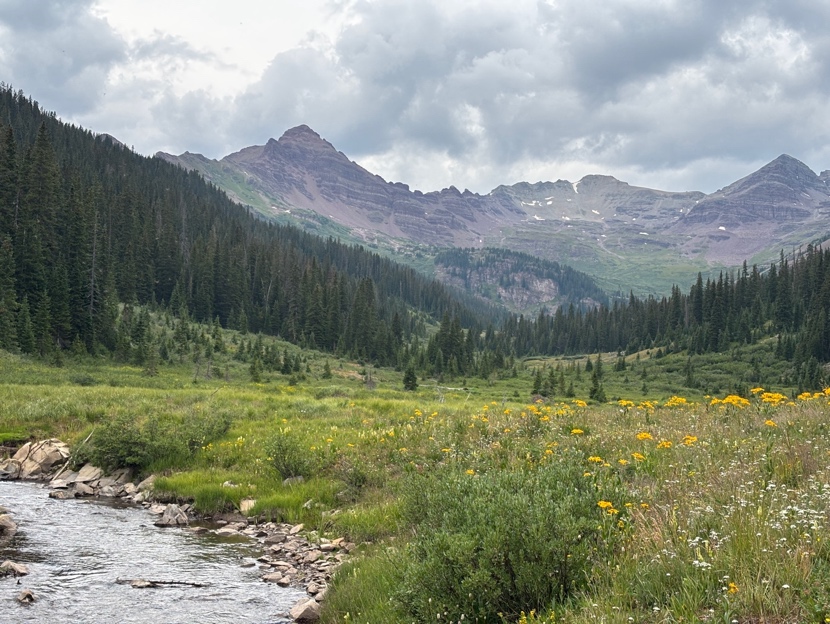

The Wilderness Land Trust, a national conservation organization, has successfully purchased the 20-acre Busher Claim in the Maroon Bells-Snowmass Wilderness to protect it from development.
The Busher Claim was one of three recent WLT purchases — the other two were a 30-acre Needle Creek property and the 31-acre Great Western Lode, both in Colorado’s Weminuche Wilderness. WLT is the only national conservation organization solely dedicated to the purchase of privately-owned lands within designated and proposed wilderness areas, aiming to remove land management conflicts that could stem from commercial, industrial, and residential development.
The Busher Claim sits above the popular hiking destination of Cumberland Basin, which is just below Pearl Mountain and Castle Peak, past Castle Creek Road out of Aspen.
“Its fragile high alpine ecosystem provides important wildlife habitat as well as pristine viewsheds for recreationists,” a press release stated. “Because it is located near the Pearl Pass Road, an OHV route from Aspen to Crested Butte, the property was at a higher risk of development.”
The Trust’s land specialist confirmed this project came from a recent mailing sent out to Colorado inholding landowners. While the price has not been released to protect landowner privacy, WLT Director of Marketing & Communications Margosia Jadkowski said it was around a couple tens of thousands of dollars.
Kim Kanas of Longmont, Colorado, supported the purchase through WLT’s Wilderness Opportunity Fund, where donors can make gifts specifically for land acquisition purposes.
“Kim has supported the Trust for many years and was particularly interested in this property and making sure it could be protected,” Jadkowski said.
WLT will now work to transfer the property to public ownership, where it will be protected as designated wilderness, the highest level of protection available to public lands. The Wilderness Act of 1964 contains a provision allowing “privately-owned land (that) is completely surrounded by national forest lands within areas designated by this Act as wilderness” to automatically become designated wilderness without an official act of Congress when transferred to public ownership.
“This provision within the Wilderness Act that allows this inholding to become wilderness without an act of Congress, it’s mending the tears in the fabric of those wilderness areas,” Jadkowski said.
Designated Wilderness Areas can only be altered by an act of Congress — not executive orders or other administration directives.
After WLT’s acquisition of the property, the trust will hold it until the U.S. Forest Service can acquire it. This is a process that Jadkowski said typically takes two to three years in Colorado, where the U.S. Forest Service will go through a due diligence that might include a separate appraisal, an environmental assessment, additional surveys, or more.
“That’s a big part of why the trust was created,” she said. “We were seeing this problem — private landowners expect to work on a much different timeline than (federal agencies). We’re able to work quickly in a competitive real estate market, and we can hold it for however long it takes for the agency to be able to acquire it.”
According to the WLT press release, there are over 275,000 acres of private property, known as inholdings, within designated wilderness areas nationwide. These properties are not protected despite being surrounded by wilderness, with the possibility of homes, resorts, timber, or mining operations being developed and threatening public access, wildlife habitat, and healthy watersheds.
