



A growing exotic pet trade has conservationists calling for stronger regulations to protect the reptiles, birds and other animals in the wild that are increasingly showing up for sale on internet marketplaces and becoming popular on social media.
The two-week Convention on International Trade in Endangered Species of Wild Fauna and Flora is scheduled to run through Friday in Samarkand, Uzbekistan. Several proposals related to the pet trade will be considered Tuesday.
Participants have proposed tighter regulations or complete bans on the trade of several species including iguanas from the Galapagos Islands, more than a dozen species of Latin America tarantulas and an odd-looking turtle from Africa.
“What we’re seeing is the pet trade much more looking at reptiles, amphibians. People want rare species and they don’t have to go into a pet shop,” said Susan Lieberman, vice president for international policy at the nonprofit Wildlife Conservation Society. “They go online and there are thousands of animals, including endangered species, illegally obtained species, all available on the internet.”
Internet drives illegal trade
In the past, the trade was dominated by sales in animal parts like elephant ivory and tiger bones. But Matt Collis, the senior director of international policy at the International Fund for Animal Welfare, said live animals for the pet trade are increasingly turning up on the internet.
“The dramatic growth in online marketplaces has put consumers directly in touch with wildlife traders and criminals around the world,” Collis said. “In today’s society where pretty much anything can be bought with a click of a button and shipped anywhere in the world in a matter of days, no wildlife is safe.”
Social media influencers, who have made owned exotic pets cool, are also contributing to the problem, Collis said.
Several of the species proposed for greater protection at the CITES conference are in Latin America, where an IFAW report last year found illegal trade is on the rise. The report, covering 18 Spanish speaking Latin American countries, says there were more than 100,000 animals seized or poached from 2017 to 2022, with seizures increasing every year.
The report found the live pet trade accounted for a growing piece of the trade, with reptiles representing about 60% of the animals, while nearly 30% were birds and more than 10% were amphibians. Many animals were traded locally or regionally but there also was evidence of animals shipped to collectors in Europe, Asia and the United States.
More than 90% of the seized wildlife destined for Europe were live animals, confirming the demand for pets was a key driver of the illegal trade, the report said.
Tortoise, vipers up for protection
Among the reptile species up for tighter trade controls is Home’s Hinged-back Tortoise, a critically endangered turtle found in West Africa that has a unique hinge on its back allowing it to close off its back legs and tail.
There are proposals to regulate the trade in two vipers species endemic to Ethiopia, two species of rattlesnake found mostly in Mexico, the leaf-tailed gecko from Australia and two species of sloths from South America, which are increasingly turning up in sloth-themed cafes in Asia.
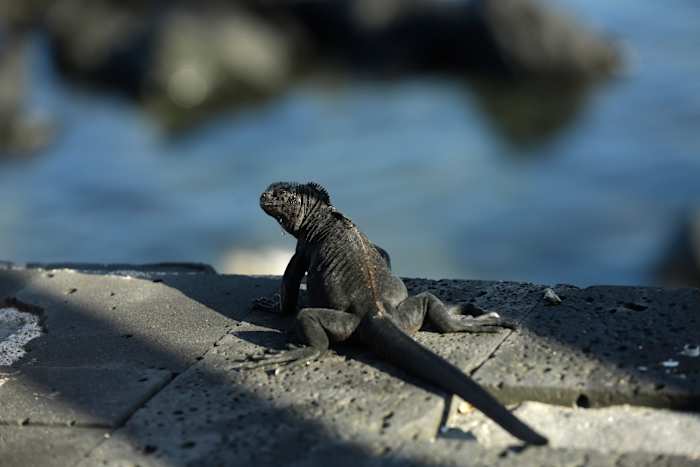
A proposal from Ecuador would ban the trade in marine and land iguanas from the Galapagos, which are listed by the International Union for Conservation of Nature as critically endangered or vulnerable. There are concerns that the illegal trade could further destabilize the population, which already faces threats from invasive species, rising tourism and fluctuations in weather associated with the El Nino.
In its CITES proposal, Ecuador said it doesn’t permit commercial export of iguanas and collecting them from the Galapagos has been prohibited for decades. But Ecuador raised concerns that traders are capturing and transporting young iguanas by boat or overland to ports and evading authorities by mislabeling them as captive bred. Most of the iguanas are destined for Japan and other Asia countries and can sell for as much $25,000 on the black market.
The United States supports the iguana, sloth, viper, tortoise and gecko proposals but is opposed to the rattlesnake listing.
CITES permits abused
A species can be banned for trade in its home range but sold online by traders who abuse the CITES permitting process and captive breeding rules and then take advantage of importing countries that don’t bother to check if the animals come from the wild, Collis said.
“In theory, under CITES rules, the countries issuing those export permits should be checking that these animals, and crucially their parentage all the way back to the founder stock, were legally acquired in order for an export permit to be granted,” Collis said. “But that is not happening.
