


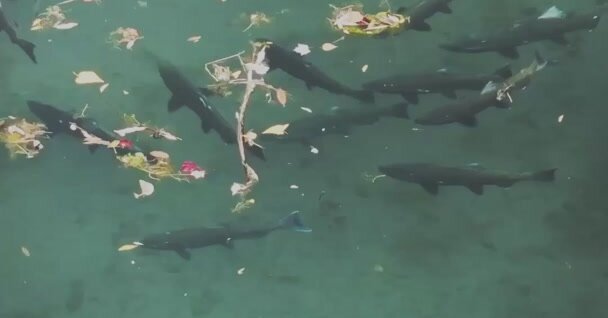

When the last of four dams on the Klamath River in southern Oregon and Northern California was demolished in October 2024, everyone who knew the river well had a question: How long would it take for salmon to reclaim the upper reaches they’d been cut off from for more than 100 years?
About 10 months later, when they began their fall migration, Chinook salmon immediately took advantage of their new river access, looking for places upstream to lay or fertilize eggs. But the fish still faced two intact dams and no one was sure if the salmon would make it through the fish ladders, structures designed for trout, a smaller species, to bypass the dams.
Then in September, a video camera caught them leaping up the ladders like pros.
William E. Ray Jr., chairman of the Klamath tribes, whose people used to rely on salmon for about a third of their diet, told me he was stunned to see the fish make it all the way to Upper Klamath Lake in Oregon in October. And they are back in the hundreds. Mark Hereford, an Oregon state fish biologist, told me he didn’t expect this magnitude of fish to return for a decade.
Salmon are tough, and they’re a reminder that although nature is sometimes very fragile, decades of conservation rhetoric have perhaps overstated that fragility. Nature can bounce back, often quickly.
From “The Lion King” to nature documentaries, we’re told that when you remove one part of a delicate ecosystem, the whole thing can come crashing down. There’s also the seemingly endless series of scientific reports about the decline of species, from frogs to birds, and the message that we are in the perilous, hopeless “sixth mass extinction” in which species are perishing at rates far above average.
Though the extinction rate for the past few hundred years has indeed been far higher than the average, out of some 1.8 million described species, humans have been the primary cause of fewer than 1,000 known extinctions since the year 1500. Claiming we are already in the sixth mass extinction event suggests that the threatened species are already doomed and there’s no possibility for them to recover.
Thank you for your patience while we verify access. If you are in Reader mode please exit and log into your Times account, or subscribe for all of The Times.
Thank you for your patience while we verify access.
Already a subscriber? Log in.
Want all of The Times? Subscribe.
