


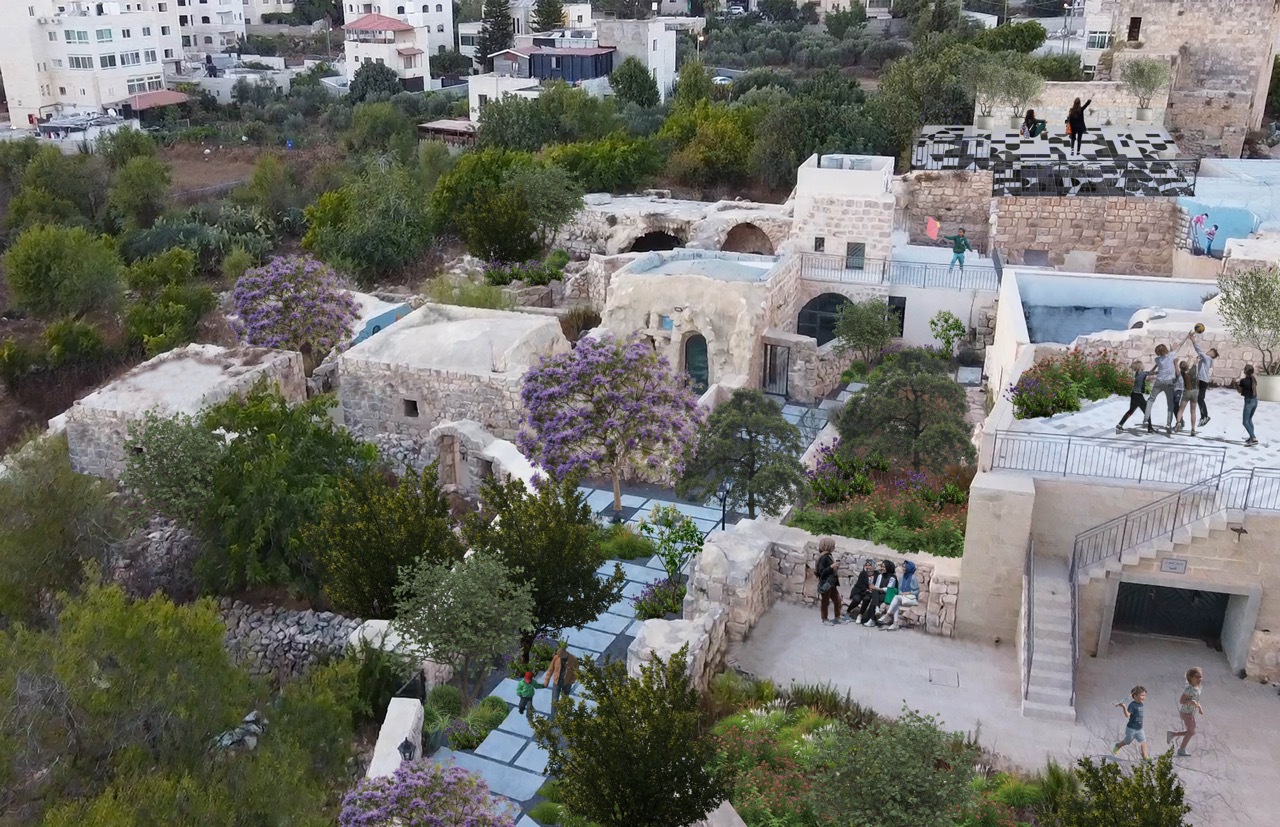

Qalandiya: the Green Historic Maze, developed by RIWAQ – Centre for Architectural Conservation, has been awarded the Grand Prize at the Holcim Foundation Awards 2025, recognizing its sensitive and deeply contextual approach to heritage conservation in Palestine, selected among the 20 winners of this year’s edition. Located in Qalandiya, north of Jerusalem, the project reactivates a historic village center long affected by political fragmentation, neglect, and spatial disconnection. Through an incremental rehabilitation strategy, the project restores deteriorated structures using traditional knowledge, local stone masonry, and native materials, transforming abandoned fabric into active public spaces while reinforcing environmental resilience through passive climate strategies and landscape-based infrastructure.
+ 5
The Holcim Foundation Awards jury recognized the project for its ability to operate within highly complex social and political conditions while maintaining a clear architectural and environmental vision. Particular emphasis was placed on the project’s participatory process, which involved residents directly in research, design, and construction, as well as its contribution to knowledge generation and transmission. Rather than treating heritage as a static object, the project was acknowledged for framing conservation as an active and evolving process that supports everyday life, collective memory, and local stewardship.
Founded in 1991, RIWAQ has spent more than three decades documenting, preserving, and revitalizing Palestinian architectural heritage across the West Bank and Gaza, with a particular focus on rural and marginalized areas. In Qalandiya, this long-term mission is reflected through close collaboration with local residents, artisans, and institutions, generating over 13,800 artisan workdays and establishing an economic model that reinvests income from restored spaces into maintenance and community life. In the interview that follows, Aya Tahhan of RIWAQ discusses how the project balances layered histories with present-day needs, and how architecture can act as a tool for reconnecting fragmented communities and sustaining collective memory.
ArchDaily: RIWAQ has been working for more than three decades to document, preserve, and revive Palestinian heritage. How does the Qalandiya Green Historic Maze reflect this long-term mission, and what does receiving the Holcim Award mean for the project and its communities?
Aya Tahhan: As you mentioned, Riwaq has been working on ensuring the cultural heritage in Palestine for a long while, but the project in Qalandiya is actually very intimate to us, as it’s a part of the rural Jerusalem cluster project. It started in 2017, when we went as a team to see different historic centers in the rural Jerusalem area. These marginalized areas, unfortunately, have been totally cut off from the city of Jerusalem after the building of the separation wall. They are very marginalized, unfortunately, and people, like, lost their connection with the city itself, but also got separated from each other as communities. So the villages themselves lost this connection, and they also lost their connection with their historic centers.
So when we went to Qalandiya, but also to other parts, we found them under the rubble. I remember our first walk in Qalandiya—we were actually walking on the rooftops of the buildings, and we didn’t know what was underneath. And people lost their connection with their historic centers, and they left them, like, since the ’70s or the ’80s, and abandoned them.
So it was important to have a project not only in Qalandiya, but also in the rural Jerusalem area. And it was important not only to work on the physical aspect, but also to work with the community itself. So we’re very proud that we are also working in Al Jib, we’re working in Bir Nabala, we’re also working in Jaba and Kafr Aqab. All of these communities right now are kind of connected to each other, and we built this network between these communities.
Whatever we have ourselves, like activities, research projects, or cultural activities, we tend to get people together to work together. But also, we can see it now: the communities themselves know each other and know the key people from each village, and now they are working together without us. And this is the gold, that the project is really sustainable, and they are working together, because sometimes we’ll finish our work, and it’s up to them to continue.
So this is the highlight of our work in the rural Jerusalem area. We are working with cultural heritage, and we are also working on the physical aspect of restoring the buildings—the amazing, beautiful historic centers that now bring people back. They have cultural activities and community-based activities in these historic centers. Some people use the alleys as playgrounds and use the public spaces there. So our final vision is to have these spaces alive and rehabilitated.
AD: How do you balance the deep historical layers of a place like Qalandiya with the urgent social, economic, and spatial needs of its present-day residents?
AT: So it works in parallel. For example, in Qalandiya, when we started there, we had like a one-year project, or actually a two-year project, just to see what was underneath all the rubble. So we found out that even the historic buildings that we knew about didn’t represent the number that was actually on the ground. At first, we thought we had 20 buildings, but later we found that there were 35 buildings. And we had alleys, we had public spaces, we had things that we didn’t know about. So this was a very important project, like, just to explore what was underneath.
And then afterwards, working with the community, seeing what the needs of the community were, do they want to use their spaces back? Do they want to go to the historic buildings and use them as residential buildings, or not? We found out that they wanted the historic buildings to be restored. And they didn’t want to go back to live there, because each family already had their own house. But they wanted them to be restored and to be full of people and alive once again.
So there were two community-based stations in Qalandiya. One of them is actually the Youth Center. We restored a building, and now it’s with them. And there’s also another one, the Women’s Association. They also have another courtyard for themselves. So these two buildings serve, of course, the people of Qalandiya and people coming from different places.
And other places, we restore them, and we set them for leases. So whoever, like artists, or people who have businesses, or different institutions that want to have centers, their centers are there. They can go to Qalandiya and be a part of Qalandiya. And the nice thing is that they have another, a new audience, because Qalandiya—it’s not only about the community itself, which is a little bit small, but it’s also about the surrounding villages of north and northwest Jerusalem, and even Ramallah, because it’s very close.
AD: So obviously, the communities they come from have a huge age range within them. How do you feel the difference between the older generation and the younger generation when it comes to reviving these spaces?
AT: For the older generation, they have very intimate memories connected to the historic buildings, how they were used, where things were located, for example, where the cattle used to be, or where weddings were held. They carry all of these memories, and restoring these buildings brings those memories back in one way or another.
For the younger generation, however, this connection to the historic center was lost, so it needs to be rebuilt. Because of this, we organize many community-based activities, not only for children, but also for adults and older people. Most of these are cultural activities that tell the story of the space and the place, while also focusing on cultural heritage more broadly. I think it is very important to rebuild this connection once again.
Going back to Qalandiya and its different layers: as I mentioned, our work there has mainly focused on the built fabric from the late Ottoman period. But over the last two years, we discovered another layer of Qalandiya that we were not aware of before—an archaeological layer. There were two archaeological excavation projects, led by experts from Palestine, and we uncovered another layer that includes a Byzantine, or possibly Hellenistic, church. It is a very large church. So it is also very interesting and exciting for us to explore these layers and to write the narrative once again. Not only the final layer that we see today, and the connection between Qalandiya and the community of Qalandiya with Jerusalem and the surrounding villages, but also the older and ancient layers. Now we know that Qalandiya has been continuously inhabited since the Hellenistic period until now. This is very important for the Palestinian narrative, because people were there all the time.
We now have evidence, not only from excavations and stone remains, but also pottery, mosaics, and other findings. So it is very important to explore and present these discoveries. And we are very proud to be part of this work, contributing to writing a Palestinian narrative, a counter-narrative to the Israeli one.
AD: In terms of documentation, you weren’t able to retrieve anything from, let’s say, existing ancient archaeological sites or anything. How was the documentation process like?
AT: Well, unfortunately, we don’t have a lot of documents talking about Qalandiya. Whenever we work on new projects in historic centers, we always do research, archaeological research, or research into anything written about the villages. Regarding Qalandiya, most of the research we found was more about the airport, for example, the building of the airport during the British Mandate.
We found pieces of written letters from people of Qalandiya, where they mentioned finding something archaeological in a certain place, and these were written to the British archaeological authorities—I’m not sure what the exact name was. But there wasn’t a lot that helped in terms of putting the puzzle pieces together.
We did find older or ancient references to Qalandiya, but they were not about the historic center itself. They were more about a buffer zone around it, because Qalandiya was first a farm used by the Romans, and it wasn’t located in the historic center. Then later, during the Crusader and Hellenistic periods, it moved into the center and gradually became larger. So, as you said, it’s like putting the puzzle back together.
AD: And how big is the team?
AT: We’re around 13; most of us are architects. One of us is a civil engineer. There is, of course, the administration. So in total, we are around 15. Palestinians. Old Palestinians, yes.
AD: Green infrastructure plays a central role in your work. How can cultivated landscapes, native materials, and traditional gardens help reclaim land, restore continuity, and support community life in fragmented territories?
AT: Well, it’s a point of our narrative to go back to using the same old materials that our ancestors used, because it’s not only about the narrative, but also about what they knew best. They knew exactly what to use, and it was more environmentally friendly than the way we build now. So when we use materials, we use stones from the same area. We use stones from demolished buildings that were left behind, and we even use the same materials for plastering, pointing, and everything else. We use new materials only in the finishing, but mainly we use the same materials that our grandfathers used.
This is also very important because for historic buildings, it’s better to use these materials when restoring them rather than new materials. New materials, for example, concrete, suffocate the building. In one way or another, the building cannot breathe. These are not breathable materials, so they damage the historic building. But when we use historic methods of maintaining these buildings, they become breathable and very natural. When you go inside these buildings, you can feel it: in winter, they are very warm inside, and in summer, they are very cool.
So in one way or another, we are reclaiming our narrative through this process. We are also raising awareness, and we do training sessions for people, for example, for those who are interested, or from the community itself, especially if they have their own historic buildings and want to maintain them. We provide training for them. Also, when we work on our projects, we ask contractors to have around 70 to 75 percent of the workers from the community itself or the surrounding areas. This way, they not only learn the techniques and the traditional materials, but it also creates jobs for them. It becomes their work; it can become their profession. So it’s really a different level of intervention there.
AD: Your project challenges the fragmentation imposed by occupation by reconnecting rural villages as one cultural cluster. In your view, to what extent can architecture help rebuild the bonds and spatial relations that politics often tears apart?
AT: For Qalandiya, and also for the other villages in the Jerusalem area, we can clearly see the disconnection and fragmentation between the villages and between them and Jerusalem. For example, when you go to Al-Ram, you can see the separation wall cutting through the village. When you go to Beit Hanina, which is also one of the villages we work in, Beit Hanina is cut in half. Half of it is outside the wall, which means it is in the West Bank, while the other half is in Jerusalem, and there is no access between the two parts.
People who used to live in Beit Hanina, and who need to maintain their Jerusalem ID, cannot stay there anymore. So when you go to Beit Hanina, to Al-Ram, and to other places, you feel like it is a ghost town, because people cannot stay there. They come and go only during holidays, for example, otherwise, these places are very quiet. You can see it on the ground, and you can also feel it.
But it is important to bring these communities together. It is important to reconnect them, and also to show them how this connection existed before. The younger generation does not know this yet. They were born seeing the wall, and they did not experience how it was before. Even for myself, I literally grew up here, I know how it was before, but in a way, you get used to it, and you stop seeing how things used to be.
When you go to Qalandiya, for example, you can see Jerusalem right there, but to go there, you have to take a long route around. What used to take five minutes now takes an hour and a half. So it is very problematic and very surreal. Whenever I go to Al-Ram, I feel the same, and when I go to Beit Hanina, I feel exactly the same.
But there is potential, there is a huge potential, to do new things that people may not have imagined before. As I mentioned earlier, we can already see this happening. For a long time, especially after the construction of the separation wall, these communities were, in a way, dead. They were in shock and did not know what to do. But after 10 or 15 years, they started to see new possibilities in different places and different hubs. They are coming back to life. We are strengthening this network and bringing these communities together, showing each other—and showing ourselves as Palestinians—that we can work together, and that we can find new potentials that we did not have in mind before.
